Three levels of GEO metrics
Think of GEO measurement in three levels, from the closest to your work to the closest to revenue.
The first level is the AI answers themselves: how often your brand is named, how often it comes first, your share of voice against competitors and which of your pages are cited. These numbers react first and are the only ones that isolate the effect of GEO. They are defined on our page about the AI visibility score.
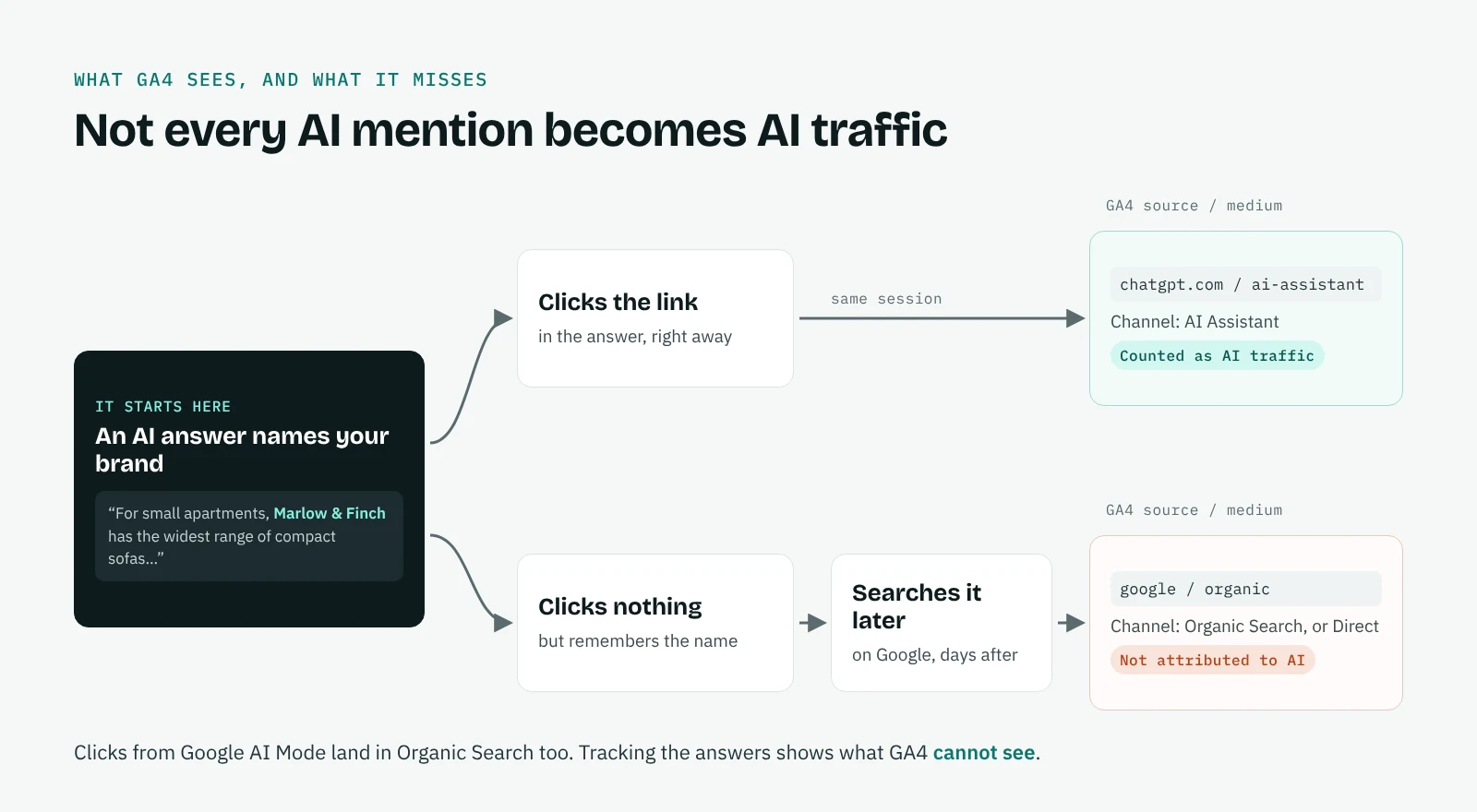
The second level is analytics. In GA4, sessions in the AI Assistant channel show the visits from assistants such as ChatGPT and Gemini; clicks from Google AI Mode stay inside Organic Search, as explained on our AI Mode page. In Search Console, growth in branded queries can be a delayed sign that more people met your name in AI answers and searched for it, and the Generative AI report shows how often your pages appear in AI Overviews and AI Mode.
The third level is business results: leads, sign-ups, sales and the share of them where customers say they found you through an AI assistant. This is where ROI is decided, and it moves last. Leads from the AI Assistant channel in GA4 are the easiest part to attribute. A simple "how did you hear about us?" field with an AI option is often the most honest data point you will get, next to the trend of your branded search.
Before and after: measuring one change at a time
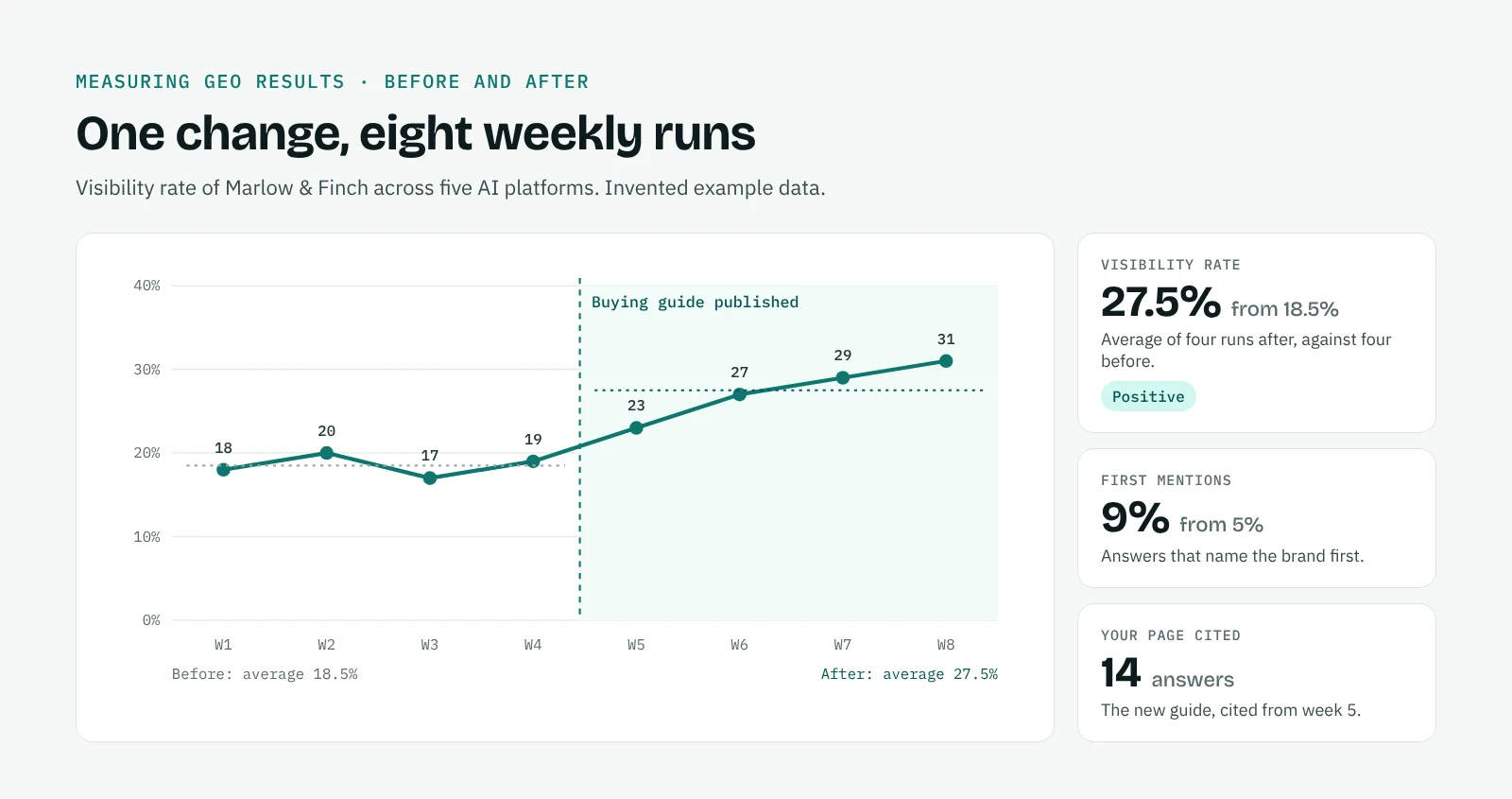
The most convincing proof of GEO is a clear before and after around a specific action. Record what you did and when: a new buying guide, a rewritten product page, a listing on a review site, a round of digital PR. Then compare the runs before that date with the runs after it, on the same questions.
Two habits make the comparison credible. Look at several runs on each side, not one, because AI answers vary from day to day. And keep everything else fixed: same questions, same platforms, same accounts, same competitors. If you change the questions at the same time as the content, you will never know which one moved the numbers.
When the action targets a source, such as a review site that AI keeps citing, check the sources as well as the mentions. Seeing your brand appear on the cited page, and then in the answers that cite it, is the clearest chain of cause and effect GEO can offer. AI citation tracking shows those sources question by question.
How long before GEO results show?
It depends on where the answer comes from. On platforms and questions where the AI searches the web, such as Perplexity, Google AI Mode and many ChatGPT answers, a change that gets indexed and cited can show within a few weeks. Answers built on what a model learned during training change more slowly, often only when a new model version is released.
That is why a first review after two to four weeks is reasonable for content and listings, while reputation work deserves a longer horizon. Set expectations with the client before you start, and report the early indicators from the first level while the slower ones catch up.
How QuotedBy measures the impact of your changes
QuotedBy runs your questions on five AI platforms from your own Chrome and keeps every answer, so each run becomes a point in the trend. After every run you see what changed since the previous one: questions where your brand appeared or disappeared, positions, new competitors and new sources. This comparison is included in every plan.
With Pro, you can log what you did, for a single question or for the whole project, and QuotedBy shows the before and after on visibility, first mentions and sources, with an outcome you can read at a glance: positive, negative or neutral. You also get an alert at the end of a run when a client drops out of a question or a new competitor appears, so you can react before the monthly report.
The results go straight into a PDF report for your client, and with Pro the answers and links can be exported to CSV or JSON for an AI search metrics dashboard in Looker Studio, next to GA4 and Search Console. Our guide on how to report AI visibility to clients shows what to put in each section and what not to promise.
Free tracking, and what Pro adds
The Free plan tracks one project on all five platforms, with three competitors, 20 active questions, the comparison with the previous run and 90 days of visible history.
Pro, at 24 € a month, adds the before and after on logged actions, alerts, full history, 10 projects, 15 competitors and 80 active questions, built-in AI analysis with no API key, CSV and JSON export and reports with your own logo.
Frequently asked questions
How do you measure GEO?
Track the AI answers to a fixed set of questions over time: how often your brand is named, how often it comes first and which pages are cited. Then compare runs before and after each action, and connect them with GA4 and Search Console data.
How do I calculate GEO ROI?
Compare the cost of the work with the business it brings: leads or sales from GA4's AI Assistant channel, customers who say they found you through AI, and growth in branded searches. Visibility gains in the answers are the leading indicator. Our guide to the SEO KPIs worth reporting shows how to put both in one scorecard.
How long does it take to see GEO results?
Changes that AI finds through web search can show within a few weeks. Answers based on what a model learned in training change more slowly, often with new model versions.
Which metrics show AI visibility tracking is working?
Visibility rate, first-mention rate, share of voice and citations of your pages, compared before and after each action on the same questions and platforms.