SEO KPIs are the few metrics that show whether organic search is doing its job for the business: being found, bringing the right visitors and turning them into customers. Most tools offer dozens of SEO metrics. A KPI is the handful you commit to, set targets for and report every month.
The list has changed. Part of search now happens inside AI answers from ChatGPT, Gemini, Perplexity, Claude and Google AI Mode, and a report built only on rankings and organic sessions misses it. This guide sorts the SEO KPIs that still matter by stage, adds the AI search KPIs a 2026 report needs, and ends with how to choose and present them.
The SEO KPIs that matter, by stage
Think of SEO as a funnel with four stages. Each stage needs one or two KPIs, not ten.
| Stage | KPI | Where to find it | What it tells you |
|---|---|---|---|
| Visibility | Non-branded impressions | Search Console, branded queries filter | Whether new people find you |
| Visibility | Share of voice on priority keywords | Rank tracker | Your visibility against competitors |
| Traffic | Non-branded organic clicks | Search Console | Discovery turned into visits |
| Traffic | Organic sessions to key pages | GA4, Organic Search | Visits where they matter |
| Results | Organic key events and conversion rate | GA4 | Leads, sign-ups or sales from search |
| Results | Organic revenue or pipeline | GA4, CRM | The business value of SEO |
| Demand | Branded clicks | Search Console, branded queries filter | How many people look for you by name |
| Health | Indexed key pages and Core Web Vitals | Search Console | Whether the site can be found and used |
Two choices make this list work. Separate branded and non-branded: mixed together, a rise in brand searches can hide a fall in discovery. And measure on key pages, not the whole site: the pages that sell matter more than total sessions.
The AI search KPIs to add in 2026
Three new sources of data make AI search measurable, at least in part.
AI visibility rate. The share of AI answers that name your brand for a fixed set of questions, tracked on ChatGPT, Gemini, Perplexity, Claude and Google AI Mode. Add the first-mention rate and share of voice next to it. No platform reports these numbers, so they come from tracking the answers. Our page on the AI visibility score shows how each is calculated.
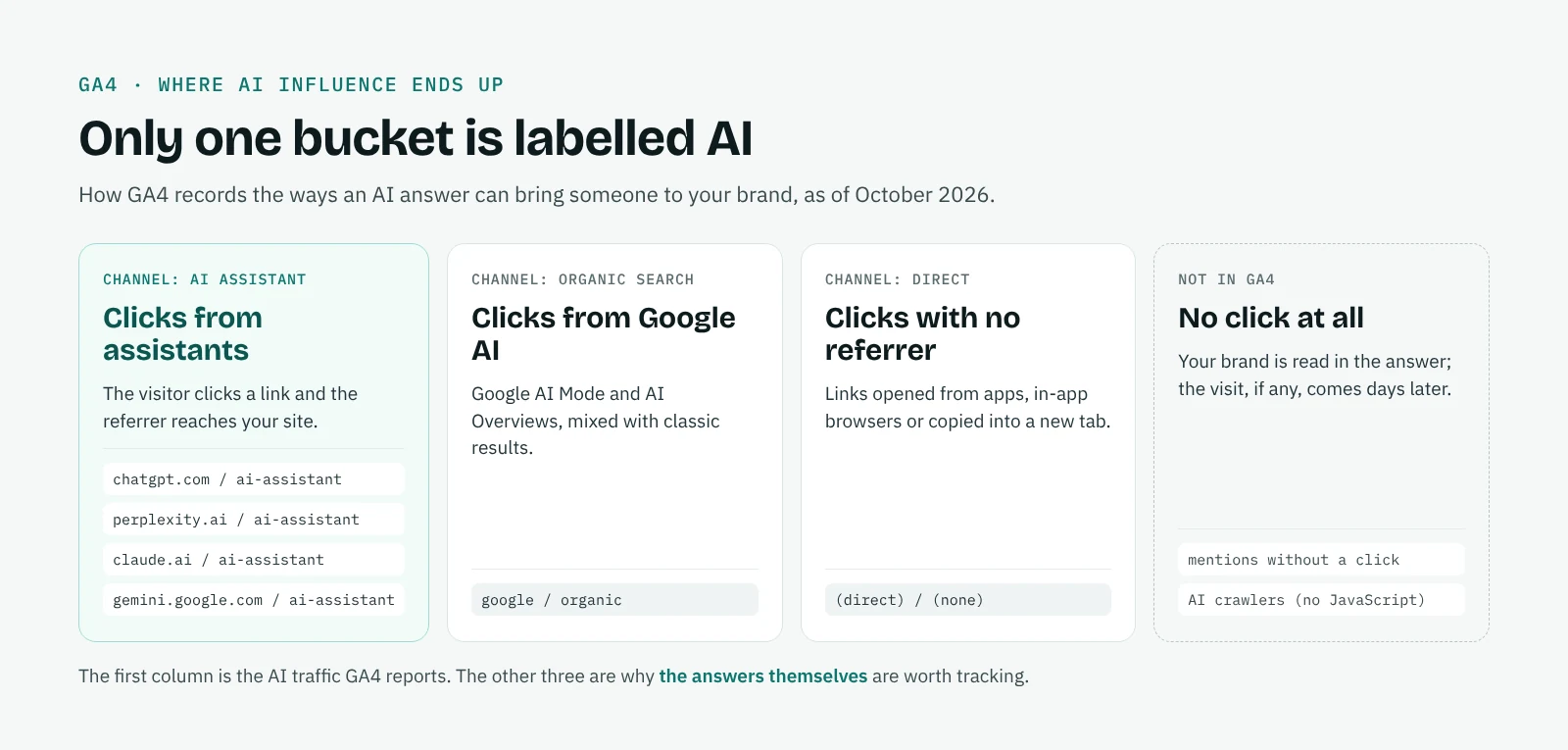
AI Assistant sessions and key events. GA4's AI Assistant channel counts visits from ChatGPT, Perplexity, Claude, Gemini and similar assistants. It misses AI Mode, which is in Organic Search, and visits without a referrer. Our guide on tracking AI traffic in GA4 explains the details.
AI impressions. Search Console's Generative AI report counts how often links to your pages appear in AI Overviews and AI Mode, by page, without queries or clicks. Our guide on the Generative AI report shows how to read it.
Branded clicks, already in the table above, complete the set: when AI answers recommend you, people often search for your name later. Our guide on branded search explains the connection.
Leading and lagging KPIs
Some KPIs move first and predict others. Visibility, AI visibility rate and share of voice are leading indicators: they change within weeks of your work. Organic key events and revenue are lagging: they follow months later and depend on much more than SEO. A good report shows both, so that early progress is visible before revenue moves and nobody mistakes a slow month for failure.
How to choose your SEO KPIs
Start from the business goal and keep five to seven KPIs in total.
E-commerce. Non-branded clicks to category and product pages, organic revenue, organic conversion rate, AI visibility rate for buying questions ("best [product] for [use]").
Lead generation and B2B. Non-branded impressions on solution topics, organic key events (demo requests, sign-ups), AI visibility rate and share of voice against named competitors, branded clicks.
Local business. Visibility for "[service] in [city]", calls and direction requests from Google Business Profile, organic key events, AI visibility rate for local questions on ChatGPT and Google AI Mode.
Whatever the model, avoid vanity KPIs: total keywords ranked, total backlinks or domain authority scores say little about results on their own. Use them to diagnose, not to report.
How to set targets
Take a baseline over the last 12 months and compare each month with the same month a year earlier, to remove seasonality. Set targets as a change on that baseline, such as non-branded clicks up 20% year on year, rather than as absolute numbers pulled from a benchmark. For AI visibility, start with a baseline run of your questions on all five platforms and set targets after two or three months of data, when you know how much the answers vary.
How to report SEO KPIs
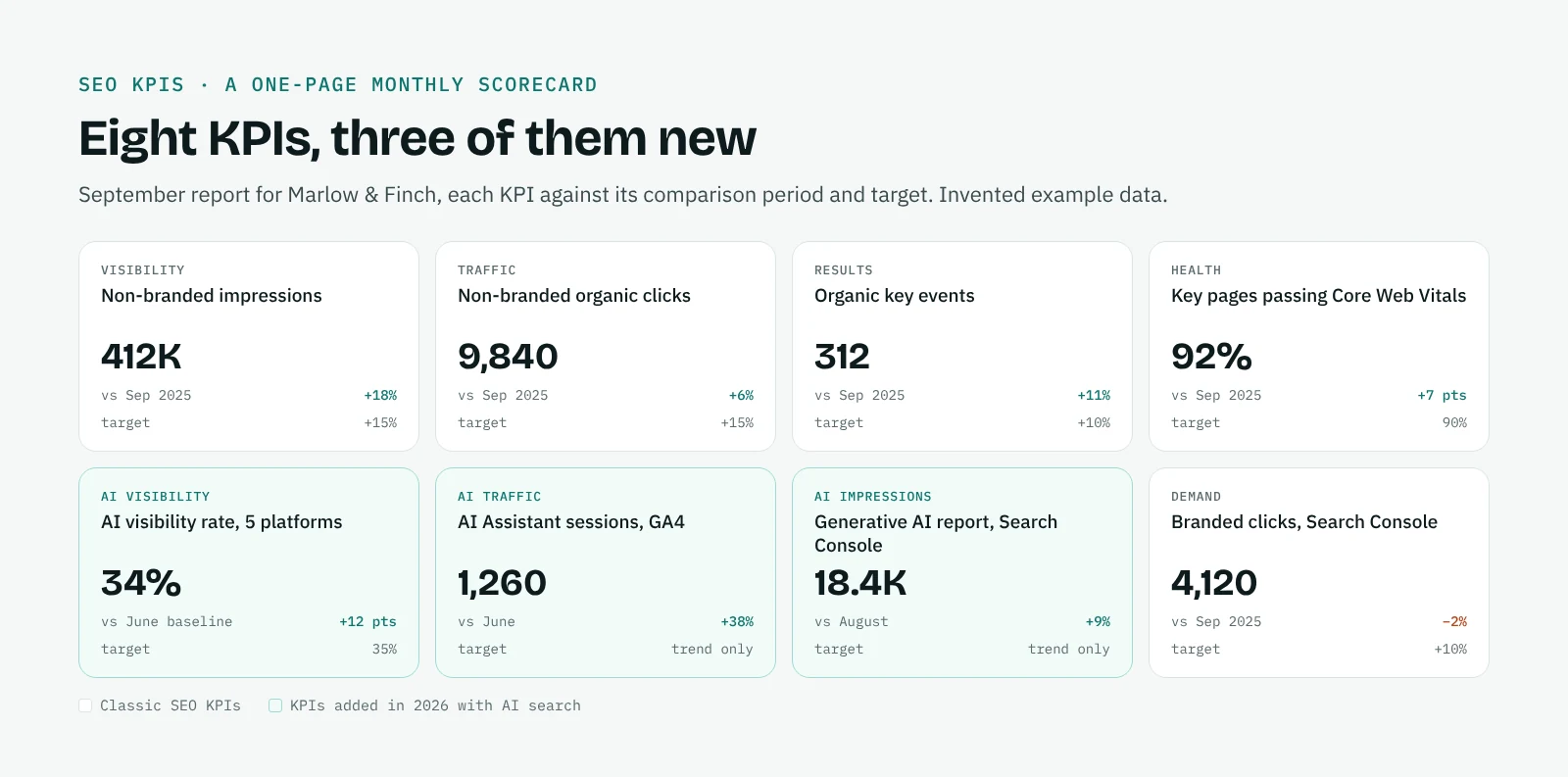
A good SEO report fits on one page and answers three questions: what changed, why, and what happens next.
- Scorecard. Each KPI with this month, the change on last year and the target. Colour only the ones that need attention.
- What changed and why. Three or four sentences connecting the numbers to the work done and to outside events, such as an algorithm update or a competitor's launch.
- Evidence from AI answers. One or two real answers that name, or fail to name, the brand. Screenshots make AI visibility concrete for a client in a way a percentage does not.
- Next steps. The actions for the coming month, each linked to a KPI.
Report monthly, with a deeper review every quarter. For the AI part, QuotedBy produces a PDF report with the answers, the sources and the trend, and the before and after view shows whether a change moved visibility. To build the AI part section by section, use our AI visibility report template.
Frequently asked questions
What are the most important SEO KPIs?
Non-branded impressions and clicks, organic key events and revenue, branded clicks and, from 2026, AI visibility rate and AI Assistant sessions. Five to seven KPIs chosen from these cover most businesses.
What is the difference between an SEO metric and an SEO KPI?
A metric is any number you can measure. A KPI is a metric you have committed to, with a target, because it shows progress towards a business goal.
Should AI visibility be an SEO KPI?
Yes, if your customers use AI assistants to choose products or services. Track it on a fixed set of questions and report it next to your organic KPIs, not instead of them.
How often should I report SEO KPIs?
Monthly for the scorecard, quarterly for a deeper review of trends and priorities.
Are rankings still a good SEO KPI?
As a diagnostic, yes; as a headline KPI, less than before. Visibility and clicks on priority keywords, and share of voice against competitors, say more than average position.