The difference between SEO and GEO is where you compete. SEO works to rank your pages in a list of search results. GEO, generative engine optimization, works to get your brand named and cited inside the answers that ChatGPT, Gemini, Perplexity, Claude and Google AI Mode write. The two overlap more than most articles admit, because AI answers are largely built from search results. They also differ in ways that change what you do and how you measure it.
If you are new to the term, start with our guide to what GEO is. This one assumes you know SEO and want to understand what is really different, what is not, and how to split your time between the two.
Generative engine optimization vs traditional SEO at a glance
| SEO | GEO | |
|---|---|---|
| Goal | Rank your pages in search results | Get your brand named and cited in AI answers |
| Where you compete | A list of ten links, plus ads and features | One written answer, often with three or four brands |
| Unit of success | A position for a keyword | A mention, its order, and a citation |
| Whose pages matter | Mostly yours | Yours and the third-party pages the AI cites |
| Main levers | Content, technical health, links | Content, mentions on cited sources, crawl access for AI bots |
| How it changes | Rankings move over weeks | Answers can change from one run to the next |
| How you measure | Search Console, rank trackers, GA4 | Repeated prompts on each platform, GA4's AI Assistant channel |
The table makes GEO look like a different discipline. In practice, the first half of the work is shared, and the second half is where GEO adds something new.
Where GEO and SEO overlap
The overlap is not a matter of opinion: the platforms document it. Google says that to appear as a supporting link in AI Overviews or AI Mode, a page must be indexed and eligible to show a snippet in Search, and that there are no additional requirements or special optimizations needed. Both features use what Google calls query fan-out: they run several related searches and build the answer from the pages those searches return. Our guide covers what Google says about AI Overviews and AI Mode in detail.
ChatGPT works in a similar way when it searches. OpenAI explains that ChatGPT search rewrites a question into one or more targeted queries, sends them to its search providers, and ranks the results it gets back. To be eligible, a site has to let OAI-SearchBot crawl it. Perplexity, Claude and Gemini also search the web for many questions and cite what they read.
The consequence is simple. Pages that are crawlable, indexed and ranking for the questions people ask are the pages AI platforms read. A site with technical problems, thin content or no authority will struggle in both. Good SEO is the entry ticket to GEO, not a separate track.
Where GEO and SEO differ
The answer replaces the list
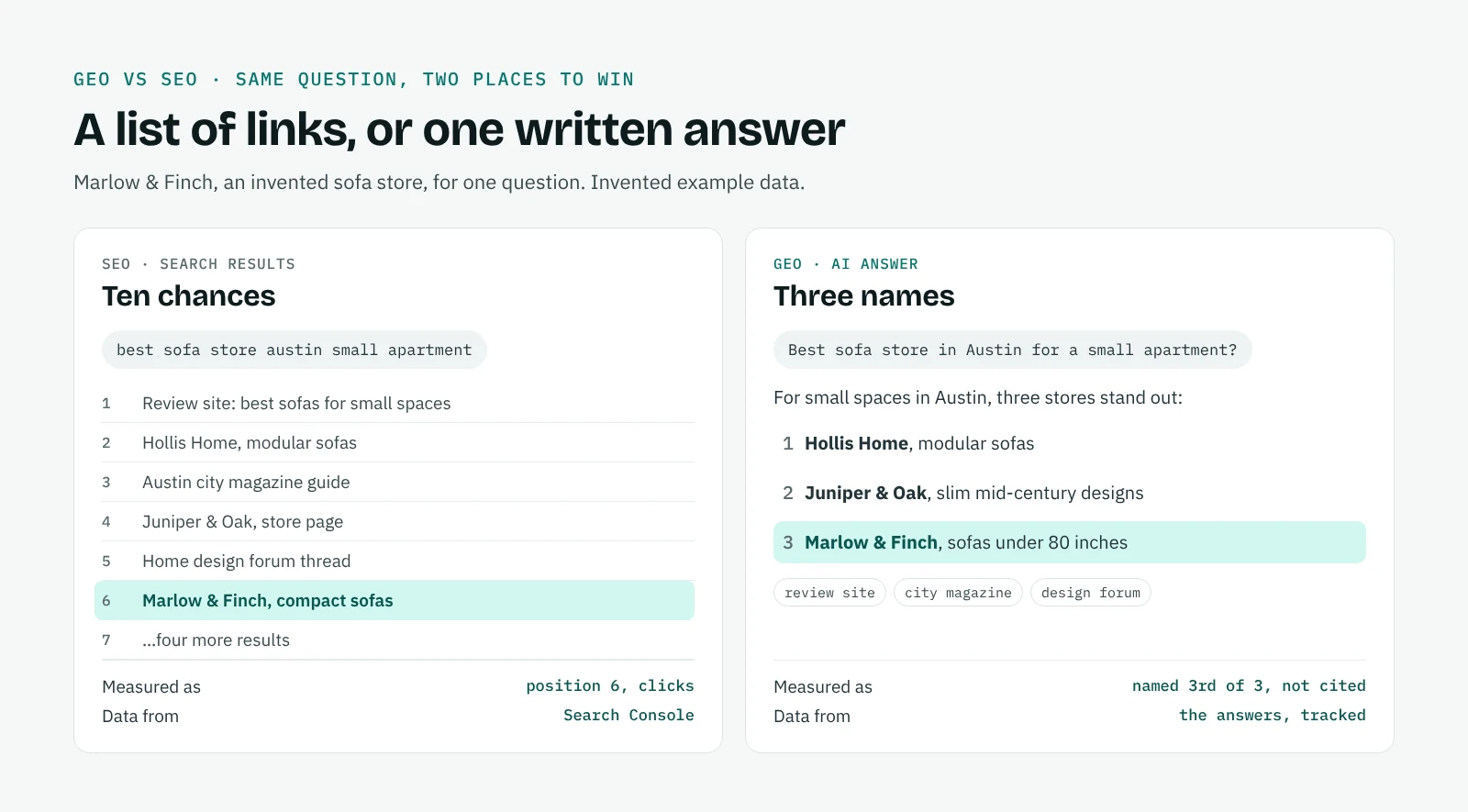
A results page gives ten chances; an AI answer gives three or four. Being sixth in Google still brings some clicks. Being left out of the answer brings nothing, and there is no page two. That makes the order of mentions matter as much as the mention itself: the first brand named is the one people remember.
Other people's pages carry more weight
When ChatGPT or Perplexity recommends a brand, the cited sources are often review sites, comparison articles, directories, forums and local press. Your own site is one source among many. GEO therefore spends more effort off-site than SEO usually does: getting listed, reviewed and quoted on the pages the AI already trusts. Links still matter, but an unlinked mention on the right page can count as much as a backlink. Our page on AI citation tracking explains how to find those pages.
Part of the answer comes from training, not from search
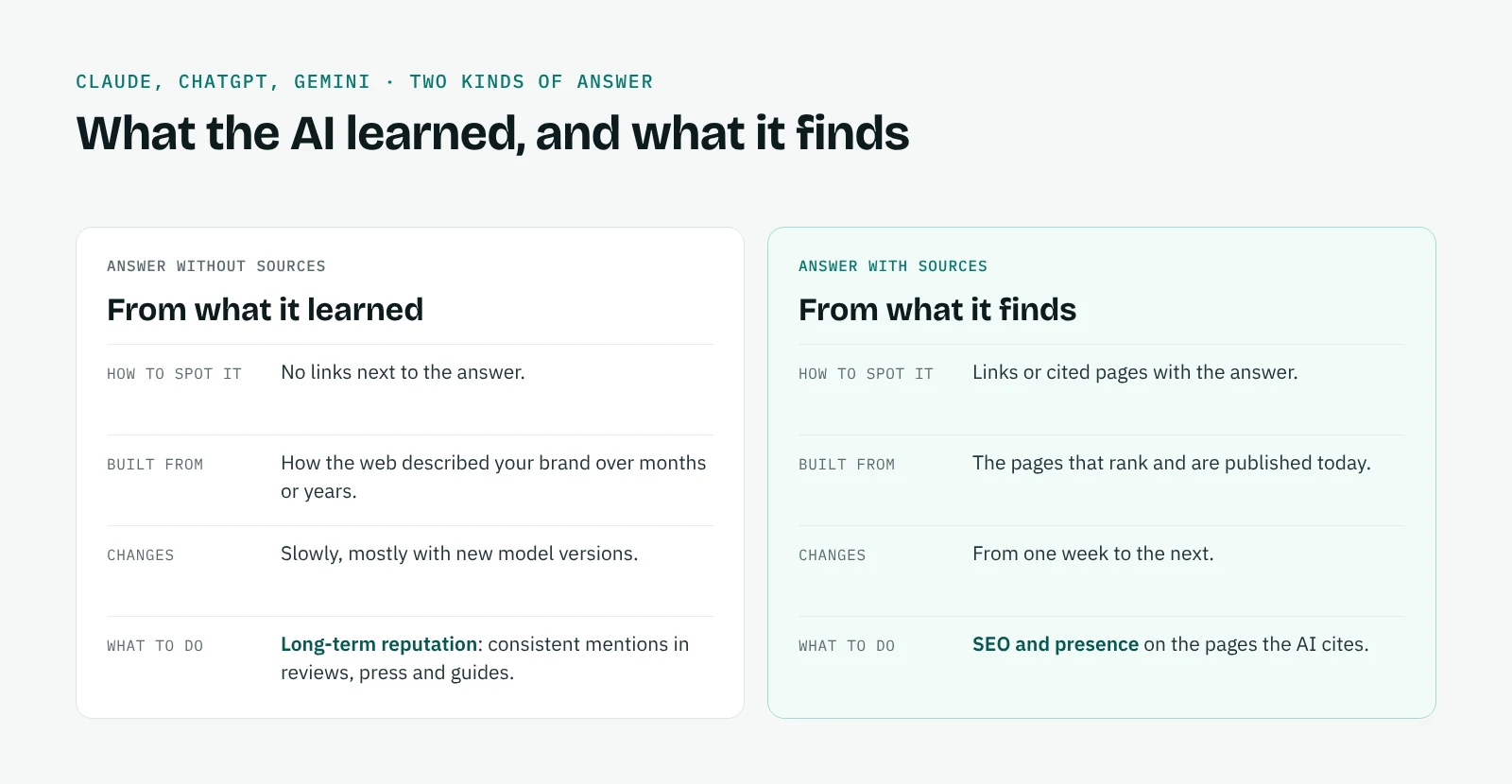
When an assistant answers without searching, it relies on what the model learned from the web over months or years. No ranking factor reaches that part directly. It reflects how consistently your brand has been described across reviews, press and guides, and it changes mainly with new model versions. SEO has no real equivalent: it is closer to brand reputation than to optimization.
Measurement starts from zero
SEO has Search Console. GEO has nothing comparable from the platforms: ChatGPT, Claude and Perplexity do not tell you how often they name your brand. Google's Generative AI report in Search Console shows impressions only, for AI Overviews and AI Mode together, without queries. You learn where you stand by asking the questions yourself, on each platform, at regular intervals.
Is optimizing content for AI search different from SEO?
Partly. The pages are the same, and so are most of the rules: answer the question people ask, make the page easy to crawl, keep it accurate and up to date. What changes is how much a page needs to work when it is read in pieces.
An AI platform rarely uses a whole page. It takes a paragraph, a figure, a definition or a list of options and combines it with pieces from other sources. Content that does well in AI answers puts the answer near the top, states facts in sentences that make sense on their own, and backs claims with numbers, dates and named sources. The research paper that coined the term GEO found that adding quotations, statistics and citations to a page raised its visibility in AI answers, while keyword stuffing made it worse than doing nothing. Writing for people, clearly, is still the best strategy for both.
Do you need both SEO and GEO?
Yes, and in most cases they are one plan with two sets of measures. A sensible order looks like this.
Start with the SEO basics, because AI platforms depend on them: crawlable pages, the right content for the questions your customers ask, a clean technical setup. Then check how AI platforms currently answer those questions. The answers tell you whether your brand is missing, named last or described wrongly, and the sources tell you where to act. For a local business, those sources are often directories, maps and local press. For e-commerce, review sites and comparison articles. For B2B software, analyst pages, review platforms and community threads.
From there, GEO adds three layers on top of SEO: presence on the sources AI cites, content written to be quoted, and open access for AI search crawlers. Our guide on how to improve brand visibility in AI search turns them into a checklist.
How to measure SEO and GEO side by side
Keep the two sets of measures next to each other, because they explain each other. On the SEO side, Search Console shows queries, impressions and clicks, and GA4 shows what organic visitors do. On the GEO side, track the answers to a fixed set of questions on each platform and summarize them as a visibility rate, first-mention rate and share of voice. Our guide on share of voice in SEO and AI search shows how the same formula works on both sides. Then add GA4's AI Assistant channel, which counts clicks from ChatGPT, Perplexity, Claude and Gemini. Our guide on tracking AI traffic in GA4 shows where to find it and what it misses.
When you change something, compare both sides over the following weeks. A new review page that starts ranking in Google and starts appearing among the sources of ChatGPT and Perplexity is the clearest sign that the two disciplines are working together. The page on how to measure GEO results explains how to read the before and after.
QuotedBy tracks the GEO side for free. It asks your questions on ChatGPT, Gemini, Perplexity, Claude and Google AI Mode in your own Chrome, saves every answer with its sources and a dated screenshot, and shows where your brand stands next to your competitors. The method is explained in how to track brand mentions in AI search.
Will GEO replace SEO?
Not as long as AI answers are built from search results, and today most of them are. What is changing is the share of attention: more questions end in an answer instead of a click, so ranking alone is no longer enough. The SEO who also tracks and improves how AI answers describe a brand covers both, and that is the role most teams are moving towards.
Frequently asked questions
Is generative engine optimization the same as traditional SEO?
No, but they overlap. Both depend on crawlable, indexed, useful pages. GEO adds work on mentions in third-party sources, content written to be quoted and measurement inside AI answers.
Do I need both SEO and GEO for my website?
Yes. AI platforms read search results to build many answers, so SEO is the foundation. GEO makes sure that foundation turns into mentions in the answers.
Is GEO just SEO with a new name?
Not entirely. The technical and content basics are shared, but GEO measures something SEO does not, the presence and order of a brand in AI answers, and it gives more weight to pages you do not own.
Can an SEO agency do GEO?
Usually, yes: the skills overlap heavily. Ask how they measure AI visibility, on which platforms and how often. If the answer is only GA4 traffic, they are measuring clicks, not answers.
Which matters more for a local business, SEO or GEO?
SEO first, including Google Business Profile and local listings, because AI platforms rely on the same directories and reviews. Then check what ChatGPT and Google AI Mode answer for "best [service] in [city]".