To rank in ChatGPT, your brand has to be among the few names ChatGPT writes into its answer, as early as possible, with your pages among the sources. There is no list of ten results to climb. ChatGPT reads, decides and writes, and the brands it names come from two places: what the model learned during training, and what ChatGPT search finds on the web when it looks things up.
You can influence both, but not in the same way or at the same speed. This guide starts from what OpenAI itself documents about ChatGPT search, then turns it into five steps you can act on, and ends with how to check whether they are working.
How ChatGPT decides which brands to name
When a question can be answered from general knowledge, ChatGPT often answers without searching. The brands it names then come from training: how the web described each brand, consistently, over a long period. Changes on your site today will not show up in those answers until a future model learns from them.
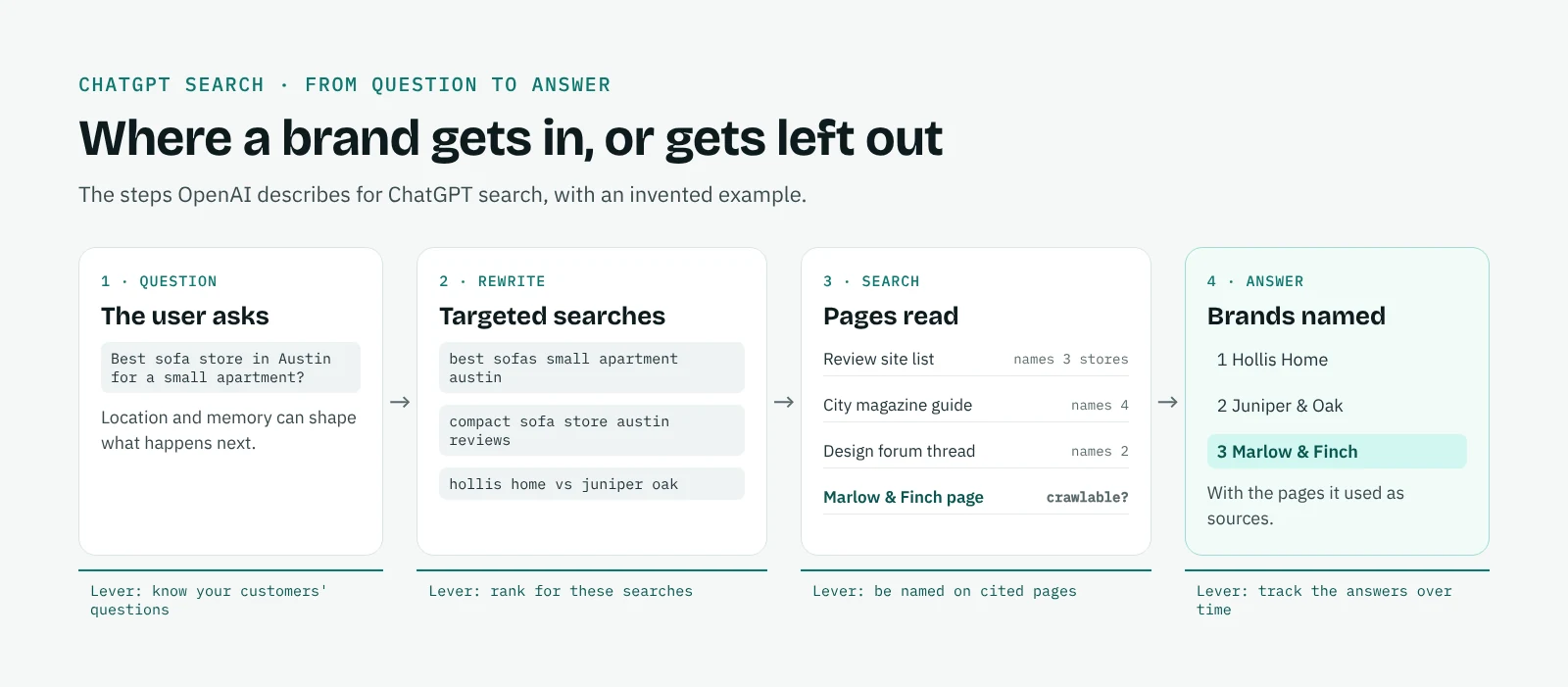
When the question needs fresh, local or commercial information, as most "best", "vs" and "near me" questions do, ChatGPT searches. OpenAI explains the process in its help pages. ChatGPT rewrites the question into one or more targeted search queries, sends them to its search providers, reviews the results and may send follow-up queries. It can use an approximate location based on the user's IP address for local results, and saved memories can shape the query. Then it ranks what it found and writes the answer, often with citations.
This second route is the one you can work on in weeks rather than months, and it behaves a lot like search, because it is built on search. That is why the steps below start with crawling and ranking.
Step 1. Make sure ChatGPT can reach your site
OpenAI uses separate crawlers for separate jobs. OAI-SearchBot finds pages for ChatGPT search, and OpenAI states that sites that block it will not be shown in ChatGPT search answers. GPTBot collects content that may be used to train models, and blocking it does not affect search. ChatGPT-User visits a page when a user asks ChatGPT to, and does not crawl on its own.
Open your robots.txt and check that OAI-SearchBot is allowed. You can block GPTBot at the same time if you prefer to stay out of training: the two settings are independent. Then check your CDN or firewall. OpenAI asks site owners to allow its published search crawler IP addresses, and some CDNs offer one-click settings that block AI bots. After a robots.txt change, OpenAI says it takes about 24 hours for search to adjust.
Example: visible in ChatGPT search, excluded from model training.
User-agent: OAI-SearchBot
Allow: /

User-agent: GPTBot
Disallow: /
Step 2. Rank for the questions ChatGPT searches
Because ChatGPT turns a question into search queries, the pages it reads are the pages that rank for those queries. A question such as "which project management tool is best for a five-person agency?" can become searches for the best tools for small agencies, comparisons between two named tools and pricing pages. If your brand is absent from the pages that rank for those searches, it is hard for ChatGPT to name it.
List the questions your customers ask, then the searches they imply: best X for Y, X vs Y, X price, X reviews, X in [city]. Make sure you have a page that deserves to rank for each, and that it does rank in classic search. OpenAI's privacy notes point to Microsoft among its search partners, so it is worth checking your pages in Bing Webmaster Tools as well as Search Console.
Step 3. Be named on the pages ChatGPT cites
For many commercial questions, the pages ChatGPT reads are not brand sites but lists, reviews, comparisons, forums and local press. If those pages name three competitors and not you, the answer will too. This is where most of the GEO work for ChatGPT happens.
Start from the sources ChatGPT already cites for your questions. Each one suggests an action: get listed in the directory, get reviewed on the review site, pitch the journalist who wrote the local guide, answer questions honestly in the community thread. Our page on AI citation tracking explains how to collect and rank those sources across many answers.
Step 4. Write pages ChatGPT can quote
ChatGPT builds answers from pieces of pages. Make your pieces easy to use: put the answer to the main question in the first paragraph, state key facts in sentences that make sense on their own, and keep prices, sizes, locations and opening hours in plain text or simple tables rather than images. Back claims with numbers and dates. Use your brand name consistently, so the model does not treat "Marlow & Finch" and "Marlow and Finch" as two different companies.
This is also what makes a page rank and convert, so it is rarely wasted work. Our guide on how to improve brand visibility in AI search has a full checklist.
Step 5. Build the reputation the model learns from
The answers ChatGPT gives without searching reflect the web's long-term view of your brand. There is no shortcut here. Consistent descriptions of what you do across your site, profiles and directories, real reviews, coverage in the press of your industry and mentions in useful guides all add up. It takes months, and the result arrives with new model versions rather than on a schedule. The difference between the two routes is explained in what GEO is.
If you sell products: ChatGPT shopping
For product questions, ChatGPT can show product results with images, prices and merchants. OpenAI states that these results are not ads and are not influenced by its partnerships. Products are chosen for relevance to the question and context, using structured metadata from providers, and when a user picks a product, merchants are ranked by factors such as availability, price, quality and whether they are the maker or primary seller.
Two practical consequences. Merchants can apply to send a direct product feed to OpenAI, and Shopify merchants are included through Shopify Catalog with no extra work. And the basics of product data matter more than ever: complete titles, prices, availability and reviews that match what the product page says.
How to check your brand visibility in ChatGPT
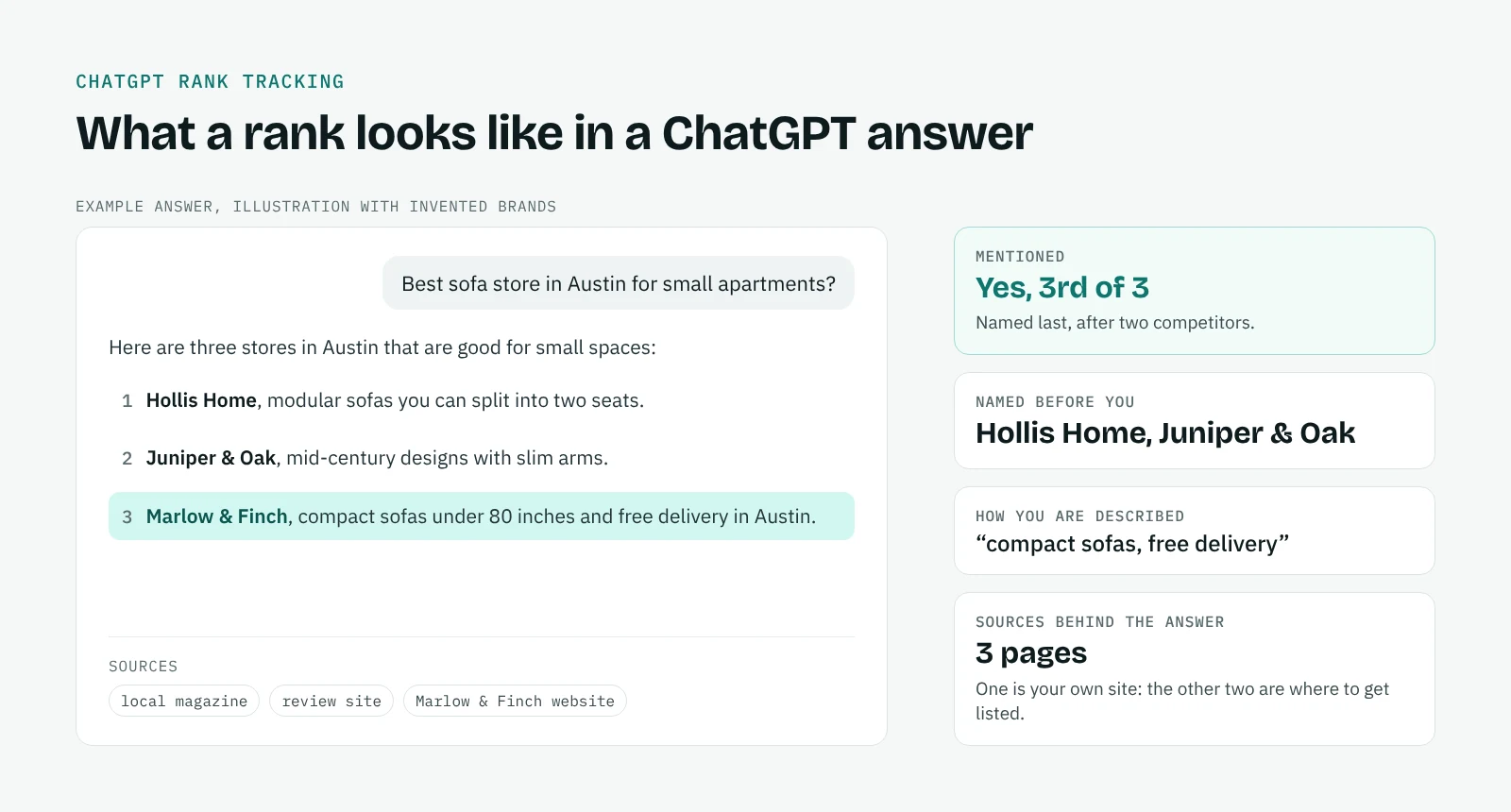
Ask ChatGPT the questions your customers ask, signed in, with the same wording every time, and record whether your brand appears, in what position, which competitors come first and which sources are cited. One check proves little, because the same question can return different brands an hour later. A fixed set of questions repeated every week shows the trend.
The ChatGPT rank tracker page shows how QuotedBy does this in your own Chrome: it types each question, you press Enter, and it saves the answer with its sources and a dated screenshot. Run the same questions on Perplexity, Gemini, Claude and Google AI Mode to see whether a gap is specific to ChatGPT. Then look at GA4: clicks from ChatGPT arrive as chatgpt.com / ai-assistant, and our guide on tracking AI traffic in GA4 shows where to find them. When you change something, the before and after view tells you whether it moved the answers.
Frequently asked questions
What search engine does ChatGPT use?
OpenAI says ChatGPT search sends rewritten queries to its search providers and uses its own crawler, OAI-SearchBot. It does not name all its providers, but its privacy notes point to Microsoft, which runs Bing.
Can you pay to rank in ChatGPT?
Not in the answers or the product results. OpenAI states that product results are selected independently and are not ads, nor influenced by its partnerships.
Why doesn't ChatGPT mention my brand?
Usually for one of three reasons: OAI-SearchBot cannot reach your site, your pages do not rank for the searches ChatGPT runs, or the third-party pages it cites name your competitors and not you. Check them in that order.
Should I block GPTBot?
It is your choice. Blocking GPTBot keeps your content out of model training but does not remove you from ChatGPT search. Blocking OAI-SearchBot does.
How long does it take to rank in ChatGPT?
Answers that come from ChatGPT search can change within weeks of a new page or a new listing ranking in search. Answers from the model's training change only with new model versions.
Is SEO for ChatGPT different from SEO for Google?
The basics are the same, because ChatGPT search relies on search results. What changes is the weight of third-party pages and how you measure results. Our guide on GEO vs SEO covers the differences.