To improve your brand's visibility in AI search engines, work on four things in order: let AI crawlers read your site, get named on the pages AI platforms cite, publish content they can quote, and measure the answers before and after every change. ChatGPT, Gemini, Perplexity, Claude and Google AI Mode each have their habits, but they all build answers from what they can read and what the web says about you.
This guide is a practical checklist. It starts with a baseline, because without one you cannot tell whether anything worked, and it ends with what not to do. If you want the theory first, read what GEO is and how GEO differs from SEO.
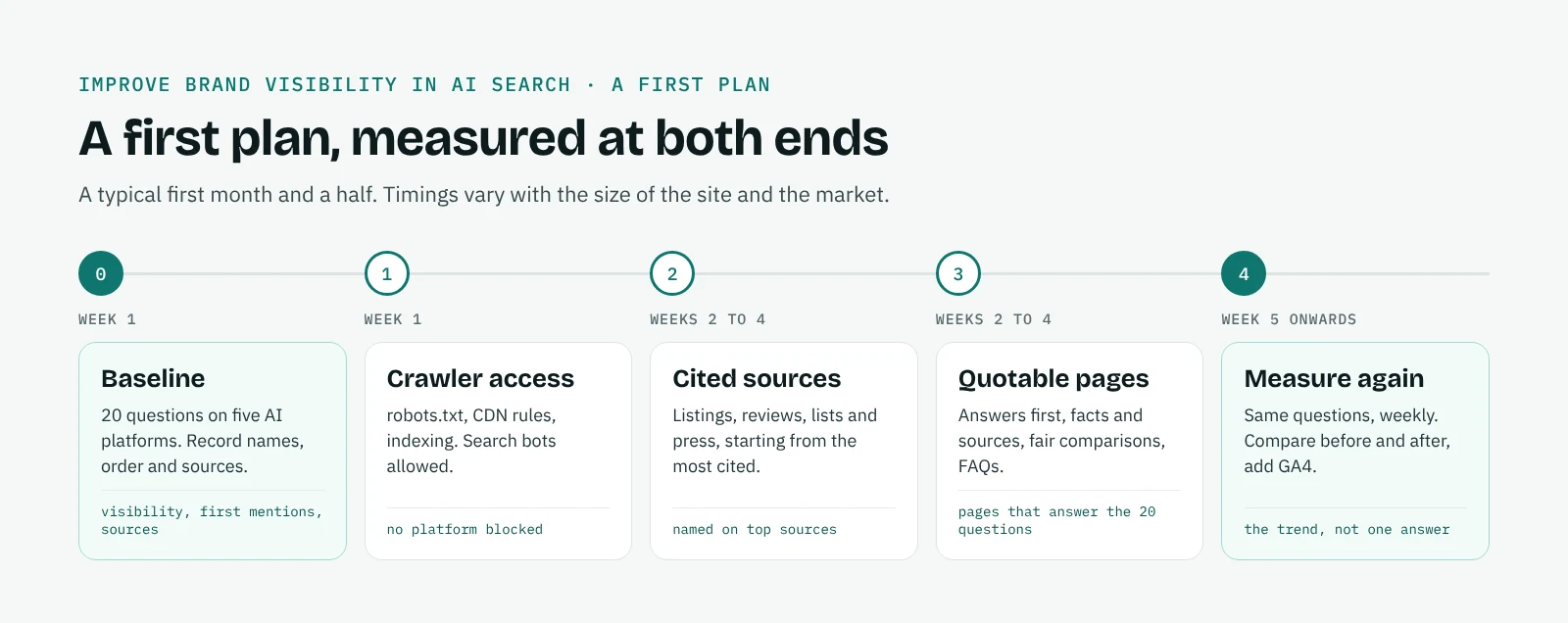
Start with a baseline
Before changing anything, find out what AI platforms say about your brand today. Write down 10 to 20 questions your customers ask, some neutral ("best accountant for freelancers in Leeds") and some that name your brand ("is [brand] good for small businesses?"). Ask each one on the five platforms and record whether your brand appears, in what position, which competitors come first and which sources are cited.
Summarize the result in three numbers: the share of answers that name you, the share that name you first, and your part of all brand mentions. Our page on the AI visibility score shows how to calculate each with an example, and how to track brand mentions in AI search explains how to keep the questions and the method consistent from one run to the next.
The baseline also tells you where to start. If you are missing from every answer, the problem is usually access or presence. If you are named but last, it is usually the sources. If you are named but described wrongly, it is the content. If other brands keep coming first, find who AI recommends instead of you and why before you change anything.
Step 1. Let AI search crawlers read your site
Each platform uses its own crawlers, and most separate the bot that feeds search answers from the bot that collects training data. Blocking the wrong one can make you invisible in a platform's answers without you noticing.
| Platform | Crawler for search answers | Crawler for model training | Fetches on user request |
|---|---|---|---|
| ChatGPT | OAI-SearchBot | GPTBot | ChatGPT-User |
| Claude | Claude-SearchBot | ClaudeBot | Claude-User |
| Perplexity | PerplexityBot | Not used for training, according to Perplexity | Perplexity-User |
| Google AI Mode and AI Overviews | Googlebot, as for Search | Google-Extended token (Gemini) |
OpenAI states that sites blocking OAI-SearchBot are not shown in ChatGPT search answers, and Anthropic warns that blocking Claude-SearchBot may reduce visibility in Claude's search results. Blocking the training crawlers does not remove you from search answers. Google-Extended needs a closer look: Google says it does not affect Google Search, but it does control whether your content can be used for grounding in the Gemini app. Blocking it may keep you out of some Gemini answers.
Three more checks complete this step. Make sure your CDN or firewall does not block these bots: some CDNs offer one-click settings that block AI crawlers. Serve your main content as HTML, not only through JavaScript. And keep indexing healthy, because Google states that to appear in AI Overviews and AI Mode a page only needs to be indexed and eligible to show a snippet. Google also says no AI text files or special schema are needed, so an llms.txt file is optional, not a requirement.
Step 2. Get named on the pages AI cites
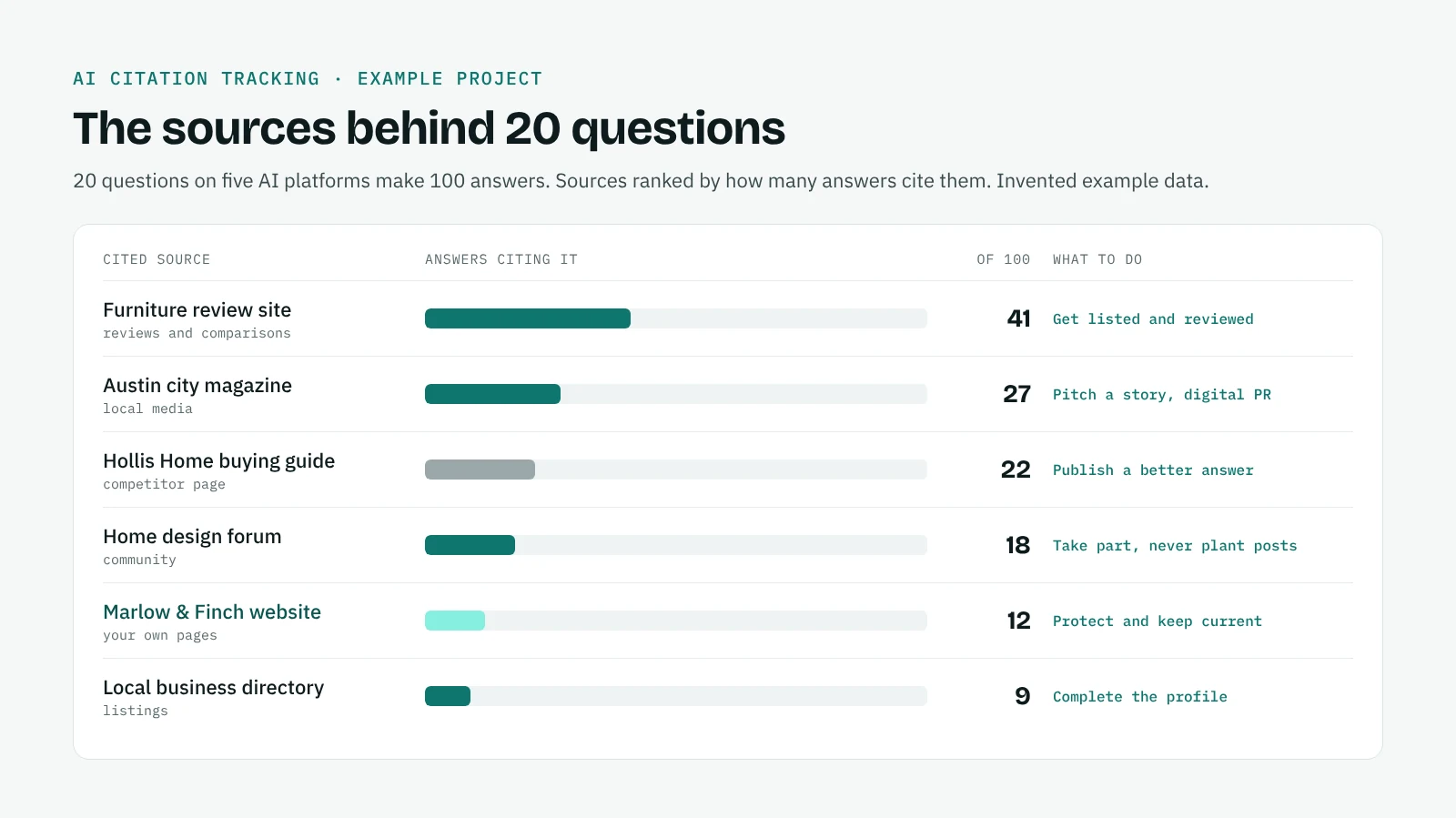
For most commercial questions, AI answers lean on third-party pages: review sites, "best of" lists, comparisons, directories, local press and community threads. If those pages name your competitors and not you, the answers will too. This step usually moves visibility more than any change on your own site.
Start from the sources the answers already cite for your questions, ranked by how often they appear. Our page on AI citation tracking explains how to collect them. Then work down the list:
- Review platforms and directories: claim and complete your profile, and ask real customers for reviews.
- Lists and comparisons: contact the author with facts that make your brand worth including.
- Local and trade press: offer a story or data that a journalist can use.
- Forums and communities: take part as yourself and answer questions honestly.
For a local or small business, the same logic is closer to home: a complete Google Business Profile, consistent details on local directories and reviews on the sites people in your area use. These are often the exact sources AI platforms read for "best [service] in [city]" questions.
Step 3. Publish content AI can quote
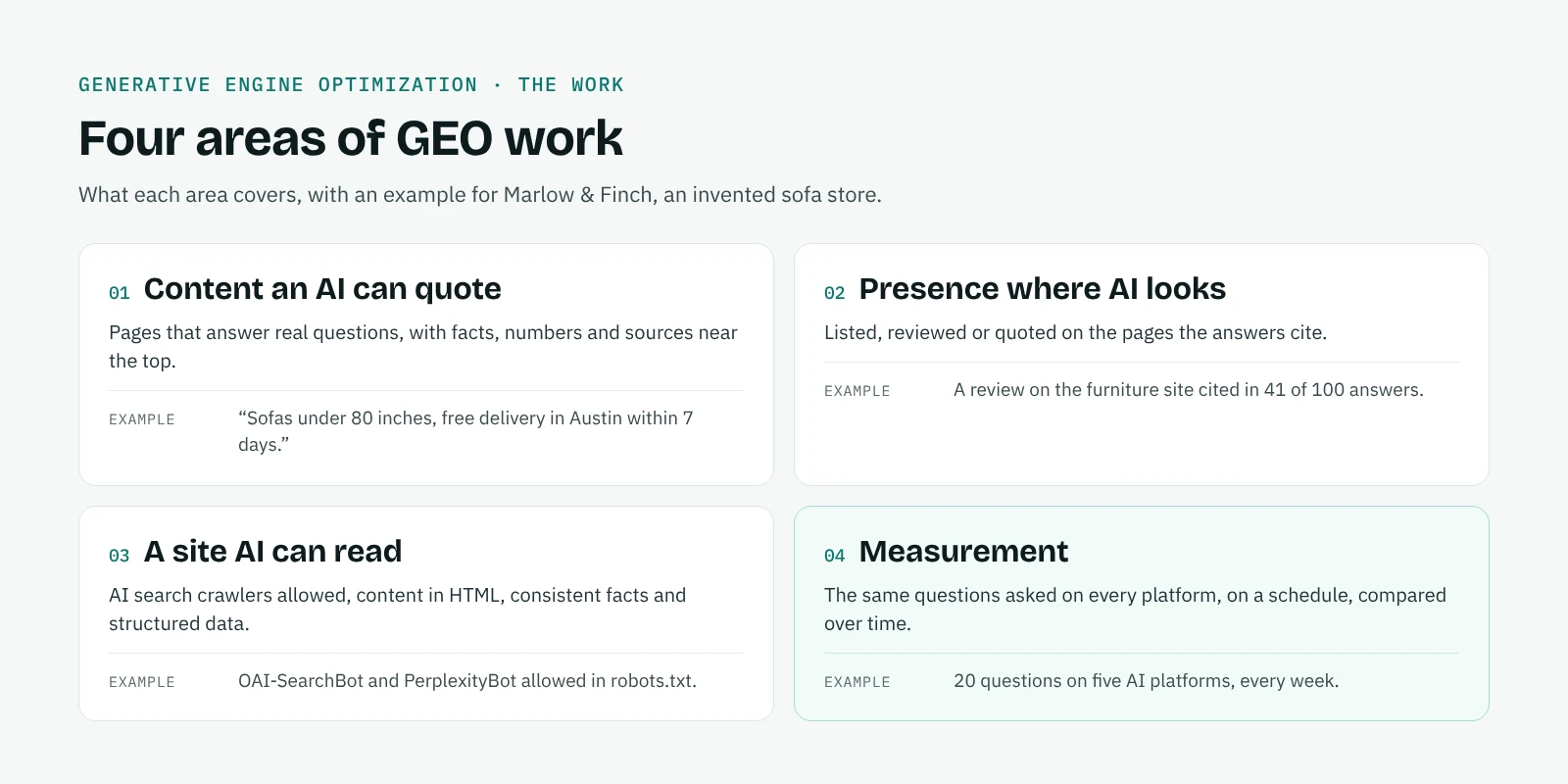
AI platforms rarely use a page as a whole. They take a definition, a figure, a short list of options or a comparison and combine it with pieces from other sources. Pages that do well in AI answers make those pieces easy to take.
Put the answer to the main question in the first paragraph. State key facts in sentences that make sense on their own, with numbers, dates and named sources. Keep prices, sizes, opening hours and specifications in plain text or simple tables. Write comparison pages that treat competitors fairly: a balanced page is more likely to be cited than a sales pitch. Build FAQs from the questions people actually ask, including the ones you found in your baseline. Show when a page was last updated, and update it when facts change.
Use your brand name the same way everywhere, on your site, profiles and directories. When structured data describes your business or products, make sure it matches what the page says: Google asks for exactly that. None of this is new to good SEO. You don't need to cut pages into tiny chunks for AI: Google says its systems understand pages with several topics, and that clear sections and headings are enough.
Step 4. Check each platform separately
The five platforms share the basics but differ in the details, so a gap on one rarely has the same cause as a gap on another.
- ChatGPT rewrites questions into search queries and reads what ranks for them. Our guide on how to rank in ChatGPT covers it step by step, and the ChatGPT rank tracker page shows how to monitor it.
- Google AI Mode uses query fan-out over Google's own index, so classic SEO weighs most here. Our guide on Google AI Overviews and AI Mode covers what Google recommends, and the Google AI Mode tracker shows how to monitor it.
- Perplexity searches for almost every question and always shows its sources, which makes it the easiest place to see which pages matter. See the Perplexity rank tracker.
- Gemini mixes what it learned with Google results, and Google-Extended affects its grounding. See the Gemini rank tracker.
- Claude answers many questions from what it learned and searches when the question needs fresh information. See the Claude rank tracker.
Step 5. Measure, change one thing, measure again
Run the same questions on the same platforms at regular intervals, weekly for most brands. When you make a change, such as a new review listing or a rewritten comparison page, note the date and compare the runs before and after. Several runs on each side tell you more than one check, because AI answers vary from one hour to the next. The page on how to measure GEO results shows how to read the difference.
Add GA4 to the picture: clicks from ChatGPT, Perplexity, Claude and Gemini arrive in the AI Assistant channel, and our guide on tracking AI traffic in GA4 shows where. When you need to share progress with a client or a manager, an AI visibility report puts the answers, the sources and the trend in one PDF.
QuotedBy does the asking and recording for you, for free, in your own Chrome. It types your questions on the five platforms, saves every answer with its sources and a dated screenshot, and shows where your brand stands next to your competitors.
What doesn't work
Some tactics promise quick wins in AI answers and either fail or backfire.
Keyword stuffing. The research that coined the term GEO found that it made pages less visible in AI answers than doing nothing.
Hidden instructions for AI. Text hidden on a page that tries to tell an AI what to say about you is easy to detect, can break trust with search engines and says the wrong thing about a brand.
Fake reviews and planted posts. Reviews you write yourself and forum posts from fake accounts are against the rules of every platform that matters, and AI answers that cite them can turn against you when they are removed.
Chasing a single answer. Changing pages after every check, because one answer left you out, wastes effort. Look at the trend across weeks.
Frequently asked questions
How long does it take to improve visibility in AI search?
Answers built from web search can change within weeks of a new listing, review or page. What models learned in training changes only with new model versions, so reputation work takes months.
What are the best practices for answer engine optimization?
Let AI search crawlers in, get listed and reviewed on the pages AI cites, write pages that answer questions clearly with facts and sources, keep brand details consistent and measure answers over time. AEO and GEO best practices are the same.
Does schema markup help AI visibility?
It helps search engines understand your pages, and AI platforms rely on search. Google says no special schema is needed for its AI features, and that structured data must match the visible text.
Do I need an llms.txt file?
No. Google says no AI text files are needed for AI Overviews and AI Mode. An llms.txt file costs little to add, but it does not replace crawler access, content and presence on cited sources.
Can a small business compete with big brands in AI answers?
Yes, especially for local and specific questions. AI answers for "best [service] in [city]" lean on local directories, reviews and local press, where a small business can be as present as a large one.