GEO, or generative engine optimization, is the practice of making a brand, its products and its content more likely to be named, recommended and cited in the answers written by AI platforms such as ChatGPT, Gemini, Perplexity, Claude and Google AI Mode. Where SEO works to earn a place in a list of links, GEO works to earn a place inside the answer itself.
The shift is easy to picture. More and more people ask an assistant "which accounting software is best for a freelancer?" and read a single answer, usually with three or four names in it and a few sources underneath. If your brand is one of those names, you are part of the decision. If it is not, there is no page two to fall back on.
This guide explains where the term comes from, how AI platforms decide what to say, how GEO relates to SEO, what the work looks like and how to measure it. It is written for SEOs, marketers and business owners who want a clear picture before spending time or budget on it.
What GEO means and where the term comes from
The term comes from a research paper, GEO: Generative Engine Optimization, published in November 2023 by researchers at Princeton University and IIT Delhi and presented at the KDD conference in 2024. The authors called the AI systems that write answers from web sources "generative engines" and tested nine ways of rewriting a web page to see which made it more visible in the generated answer.
The results are still a useful starting point. The best methods raised visibility by up to 40% over the original page. Adding quotations, statistics and citations to credible sources worked best. Keyword stuffing, the oldest trick in SEO, scored below the unedited page. Generative engines reward content that reads like evidence, not content that repeats a phrase.
Since then, GEO has moved from research papers to agency service pages, and the word now covers more than rewriting text. It includes where your brand is mentioned across the web, whether AI crawlers can read your site and how you measure the outcome.
GEO, AEO, LLMO, AI SEO: one practice, several names
You will meet several labels for the same work. AEO, answer engine optimization, is the oldest: it was coined for featured snippets and voice assistants, and today it usually means optimizing for AI answers too. LLMO (large language model optimization) and AI SEO are used in the same way, mostly by agencies and tool vendors. GEO has become the most common term, and it is the one we use on this site.
The differences between the labels are mostly marketing. What matters is the outcome they all describe: your brand in the answer, described correctly, with your pages among the sources.
How AI platforms decide what to say
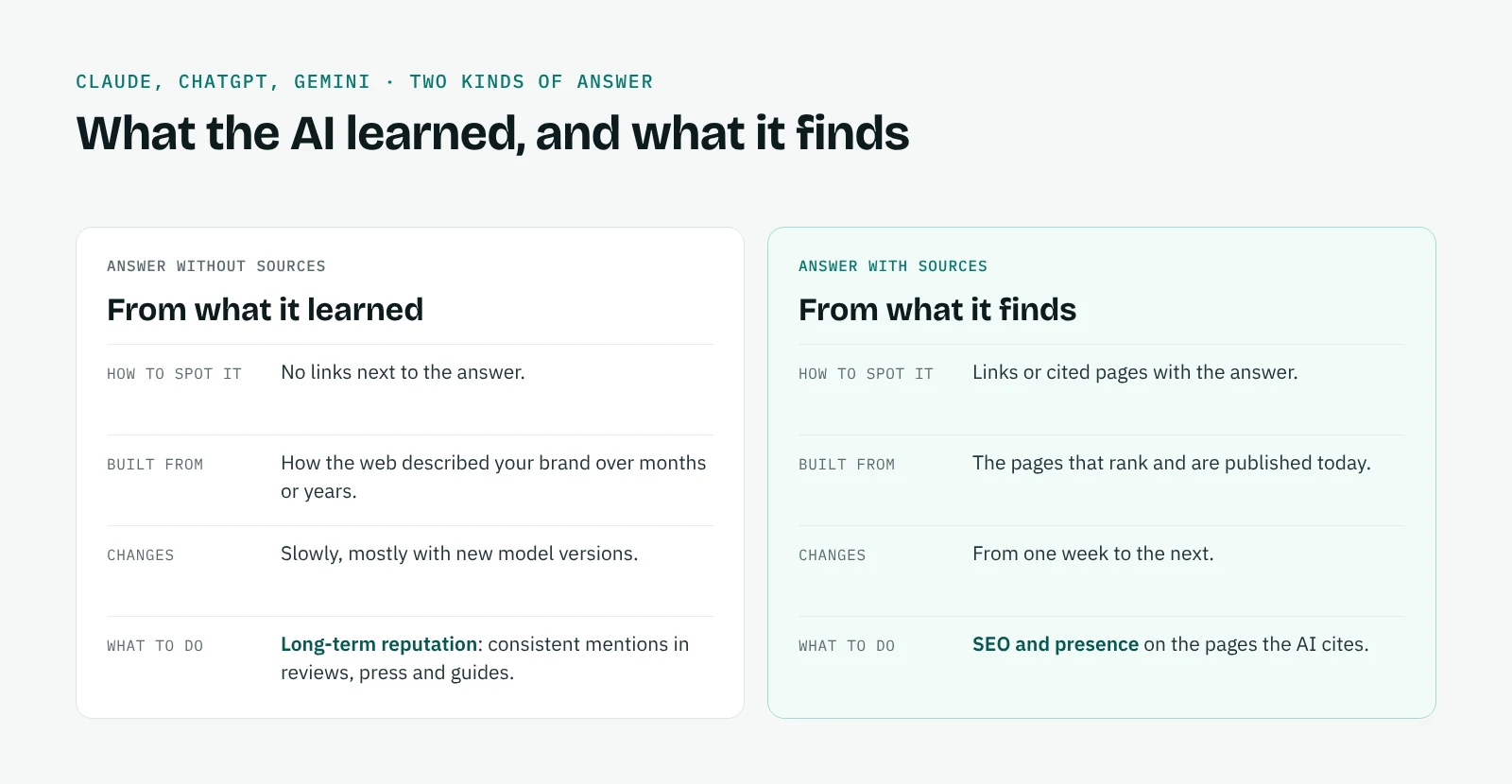
Every AI answer about brands draws on two kinds of knowledge, and GEO has to work on both.
The first is what the model learned during training: how the web described your brand over months or years. When ChatGPT, Claude or Gemini answer without searching, this is all they have. It changes slowly, mostly with new model versions, and it rewards brands that have been discussed consistently in reviews, press, guides and forums for a long time.
The second is what the platform finds when it searches the web at the moment of the question. Perplexity and Google AI Mode search almost every time and show their sources next to the answer. ChatGPT, Claude and Gemini search when the question needs fresh or local information. Google calls the technique behind AI Mode query fan-out: the question is split into several related searches, and the answer is built from the pages they return. Our guide explains how Google picks sources for AI Overviews and AI Mode. This side can change from one week to the next, and it is where SEO and GEO meet, because the pages that rank are the pages that get read.
One more distinction changes what you measure. A brand can be mentioned, named in the text of the answer, or cited, linked as a source. The two often go together, but not always: a review site can be cited in an answer that recommends your competitor, and your brand can be named on the strength of pages you don't own. Our page on AI citation tracking explains how to read both.
GEO and SEO: what changes and what doesn't
GEO does not replace SEO. A large part of what AI platforms read comes from search results, so a site that ranks well, loads fast and answers questions clearly starts with an advantage. Technical health, useful content and authority still count.
What changes is the unit of success and the place where you compete. In SEO you win a position on a results page and measure clicks. In GEO you win a mention inside an answer, often with no click at all, and the pages that shape that answer are frequently not yours: review sites, directories, comparisons, forums and press. The full comparison, with a table of the differences, is in our guide to GEO vs SEO.
What GEO work looks like in practice
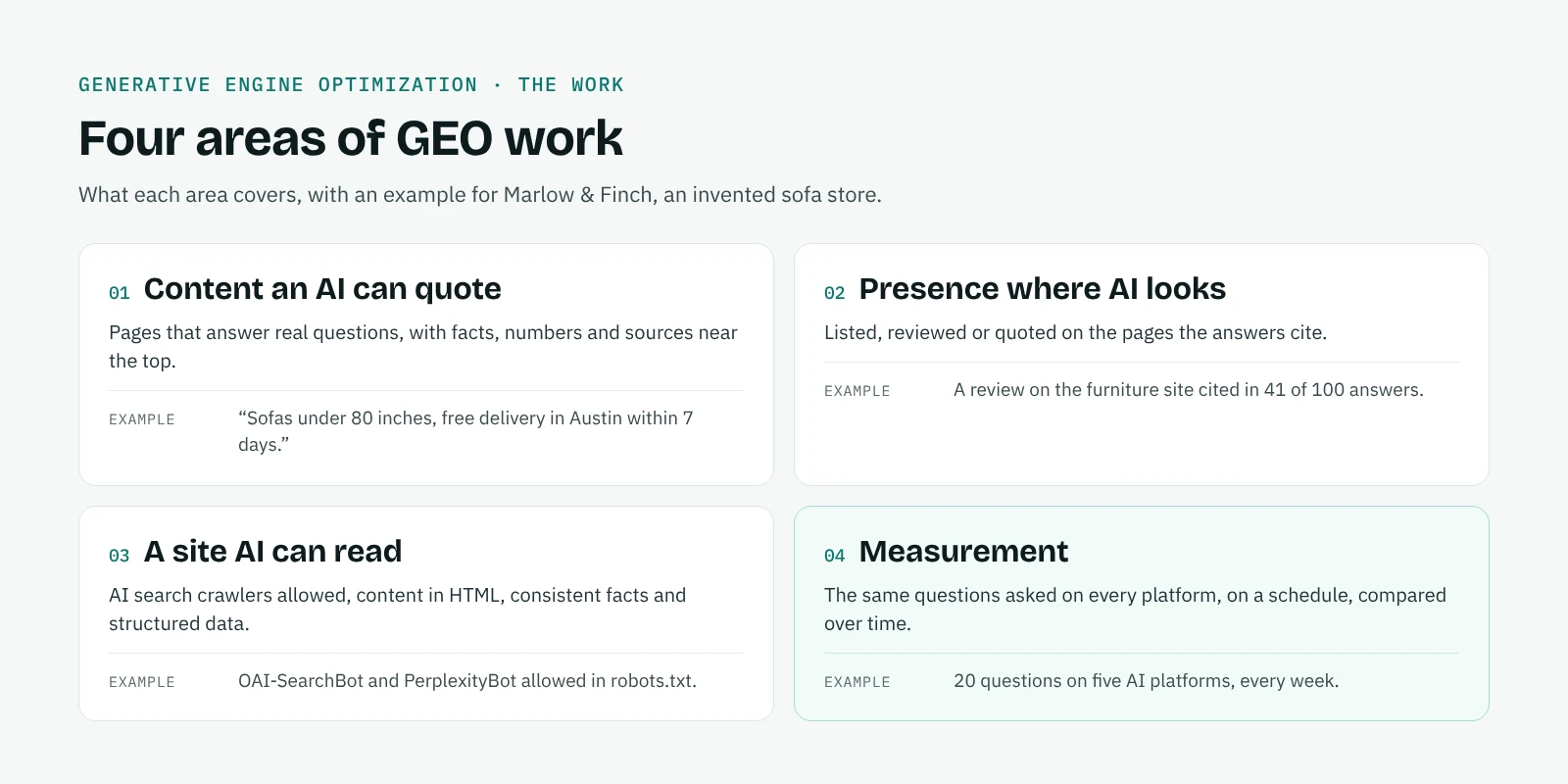
GEO work falls into four areas. Most brands need some of each, in proportions that depend on what the answers in their category rely on.
Content an AI can quote
Write pages that answer the questions your customers ask, in the words they use, with the answer near the top. Support claims with numbers, dates, named sources and short statements that stand on their own. A page that says "delivery in 48 hours to 30 cities" gives an AI something to repeat; a page that says "fast delivery everywhere" does not.
Presence where AI looks
The pages cited in your category are the shortlist of places your brand needs to be: a review platform, a trade directory, a comparison article, a local magazine, a community thread. Being listed, reviewed or quoted there is often worth more than another page on your own site. Find out which sources keep appearing before deciding where to invest.
A site AI can read
Check robots.txt first. Blocking a platform's search crawler keeps your pages out of its answers. OpenAI, for example, uses OAI-SearchBot for ChatGPT search and GPTBot for model training, and the two can be allowed or blocked separately. Serve the main content as HTML rather than only through JavaScript, keep facts such as prices and opening hours consistent across your site and profiles, and use structured data to make your brand and products unambiguous.
Measurement
Without it, GEO is guesswork, and it is the area most brands skip. The next section explains what to measure.
Our guide on how to improve brand visibility in AI search goes deeper into each area, and how to rank in ChatGPT applies them to the most used assistant.
How to measure GEO
GEO is measured in two places: in the answers and in your analytics. What the answers show is often called your LLM visibility.
In the answers, you ask a fixed set of questions on each platform at regular intervals and record what comes back. Four measures sum up the result: the visibility rate (the share of answers that name your brand), the first-mention rate (the share that name you first), the share of voice (your part of all mentions of the brands you track) and the sources cited. Our page on the AI visibility score shows how each is calculated with a worked example, and how to track brand mentions in AI search walks through the method step by step. Each platform answers in its own way, so track them separately: ChatGPT, Google AI Mode, Perplexity, Claude and Gemini.
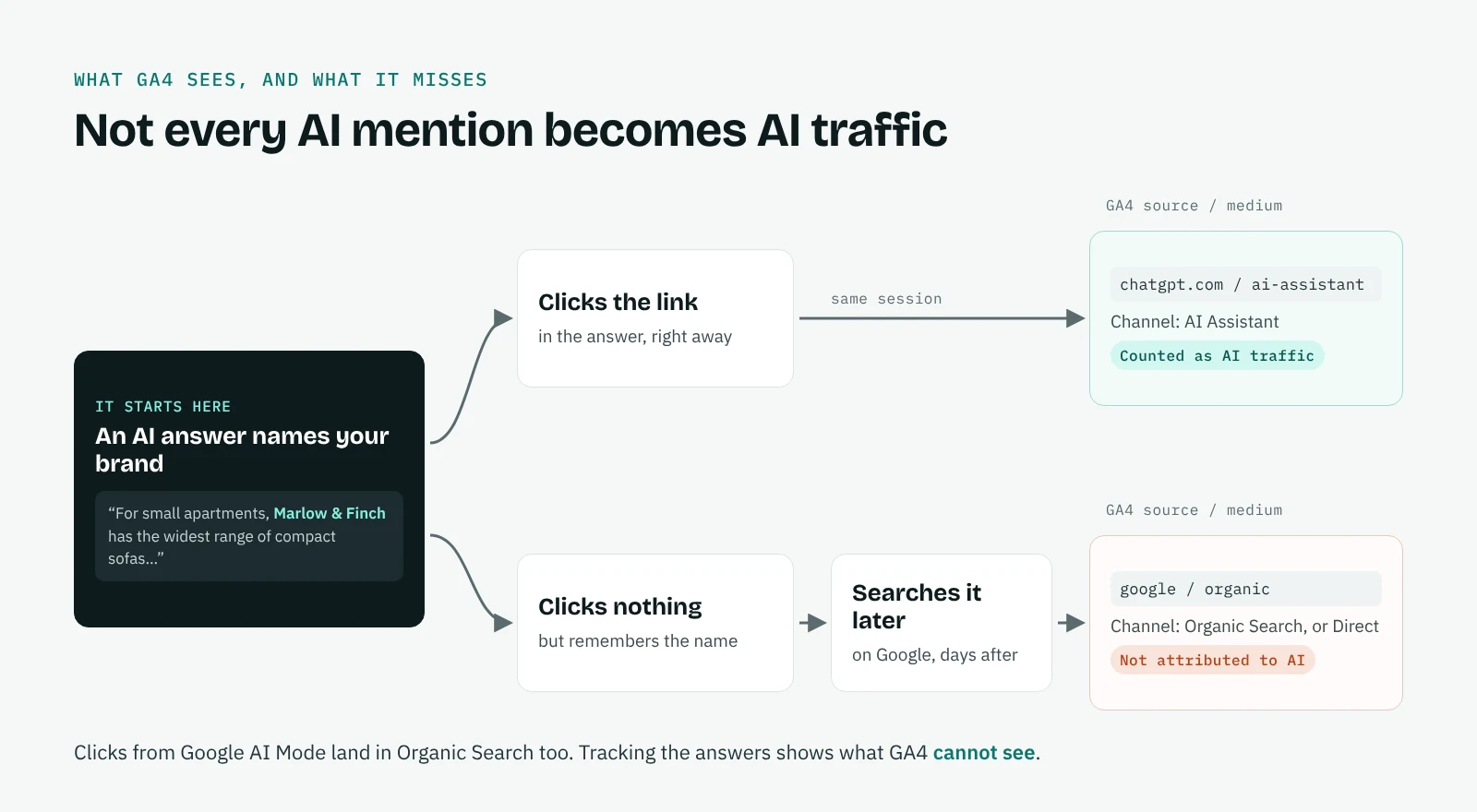
In analytics, GA4 now has a default channel called AI Assistant. In a high-traffic GA4 property we checked in October 2026, sessions from chatgpt.com, perplexity.ai, claude.ai, gemini.google.com and copilot.com all landed there, with ai-assistant as the medium. Clicks from Google AI Mode and AI Overviews do not: they stay in Organic Search, and Search Console's Generative AI report shows only their impressions. And no channel sees the people who read your name in an answer and search for you days later. Our guide on tracking AI traffic in GA4 covers the reports and their limits.
When you change something, compare the answers over several runs before and after, never a single check. The page on how to measure GEO results shows how to read the difference, and the AI visibility report turns it into something a client or a manager can read in five minutes, next to your SEO KPIs.
How to start with GEO this week
You don't need a budget to take the first step. You need a baseline: a picture of what AI platforms say about your brand today.
- Pick 10 to 20 questions your customers ask, some neutral ("best sofa store in Austin") and some that name your brand.
- Ask them on ChatGPT, Gemini, Perplexity, Claude and Google AI Mode, and record which brands are named, in what order, and which sources are cited.
- Read the sources: they tell you where your brand needs to be present and which content is missing.
- Change one thing, then ask the same questions again over the following weeks and compare.
QuotedBy does steps 2 and 4 in your own Chrome, for free. It types each question on the five platforms, saves every answer with its sources and a dated screenshot, and shows you where your brand stands next to your competitors.
Frequently asked questions
What does GEO stand for in marketing?
Generative engine optimization: improving how a brand appears in answers written by AI platforms such as ChatGPT, Gemini, Perplexity, Claude and Google AI Mode.
Is GEO the same as AEO?
In practice, yes. AEO, answer engine optimization, is older and was born with featured snippets and voice search. Today both terms describe optimizing for AI answers.
Does GEO replace SEO?
No. AI platforms read search results to build many of their answers, so SEO remains the foundation. GEO adds the work on mentions, sources and measurement inside the answers.
How long does GEO take to show results?
Answers built from web search can change within weeks of a new page, a new listing or a new review. What models learned in training changes only with new model versions, so reputation work takes months.
Can I do GEO for free?
Yes, to start. You can check answers by hand, or use the free plan of QuotedBy, which covers one project, 20 prompts and all five AI platforms.
Does llms.txt help GEO?
It is a proposed convention, not an official web standard like robots.txt, and Google says its Search does not use it. Adding one costs little, but it is no substitute for useful content, presence on the sources AI cites and open access for AI crawlers.