LLM visibility is how often, and how well, AI assistants built on large language models name your brand when people ask about your market. It covers ChatGPT, Gemini, Claude, Perplexity and Google AI Mode, and it is the AI-search equivalent of rankings: not a position on a page, but your place in the answers people read.
Unlike rankings, no platform reports it. ChatGPT does not tell you how often it recommends you, and Google's Generative AI report in Search Console shows impressions without queries. LLM visibility is something you measure yourself, from the answers. This guide explains what it is made of, how to check it, and where to go next if the result is not what you hoped.
What LLM visibility is made of
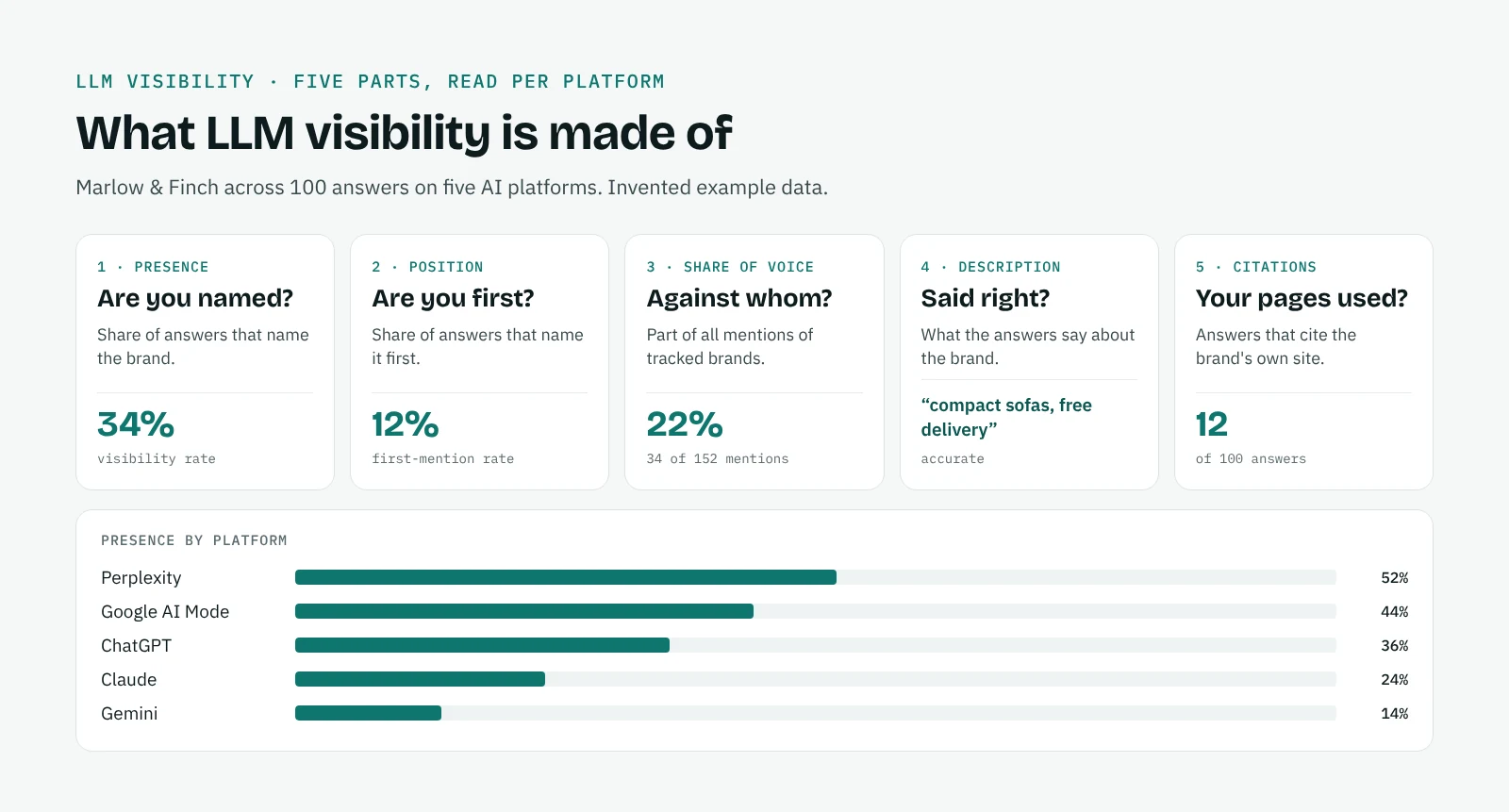
A single "visibility score" hides more than it shows. LLM visibility is easier to understand, and to improve, when you split it into five parts.
Presence. The share of answers that name your brand at all. This is the base number, often called the visibility rate.
Position. Where you appear in the answer. Being named first is worth more than being fourth in a list of four, and the first-mention rate captures it.
Share of voice. Your part of all mentions of the brands you compete with. It tells you whether you are gaining or losing ground, not just whether you appear. Our guide to share of voice covers the calculation, and share of search measures the same idea on the demand side.
Description. What the answer says about you. A mention that gets your prices, location or main product wrong can do more harm than no mention.
Citations. Whether the answer links to your pages as a source, and which other pages it relies on. A brand can be mentioned without being cited, and the other way round: our page on AI citation tracking explains the difference.
Each part should be read per platform, because the same brand can be strong on Perplexity and almost absent on Gemini.
Why LLM visibility differs from platform to platform
LLM answers come from two places: what the model learned during training, and what the platform finds when it searches the web for the question. The balance changes from one platform to another and from one question to another. Perplexity and Google AI Mode search almost every time and show their sources. ChatGPT, Claude and Gemini often answer from what they learned and search when the question needs fresh or local information.
This is why your LLM visibility can move in two ways: quickly, when the pages AI platforms find change, and slowly, when new model versions learn a different picture of your market. Our guide on what GEO is explains both routes.
How to check your LLM visibility by hand
You can get a first picture in an hour.
- Write 10 to 20 questions your customers ask, mostly neutral ("best project management tool for a small agency") and a few that name your brand.
- Ask each question on ChatGPT, Gemini, Claude, Perplexity and Google AI Mode, signed in, with the same wording everywhere.
- For each answer, note whether your brand appears, its position, which competitors are named, what is said about you and which sources are cited.
- Count the results: presence, first mentions and share of voice, overall and per platform.
The limits appear quickly. Answers change from one hour to the next, so one round proves little; you need the same questions repeated over weeks. And copying 100 answers into a spreadsheet every week is where most manual checks stop.
How to check LLM visibility with a tool
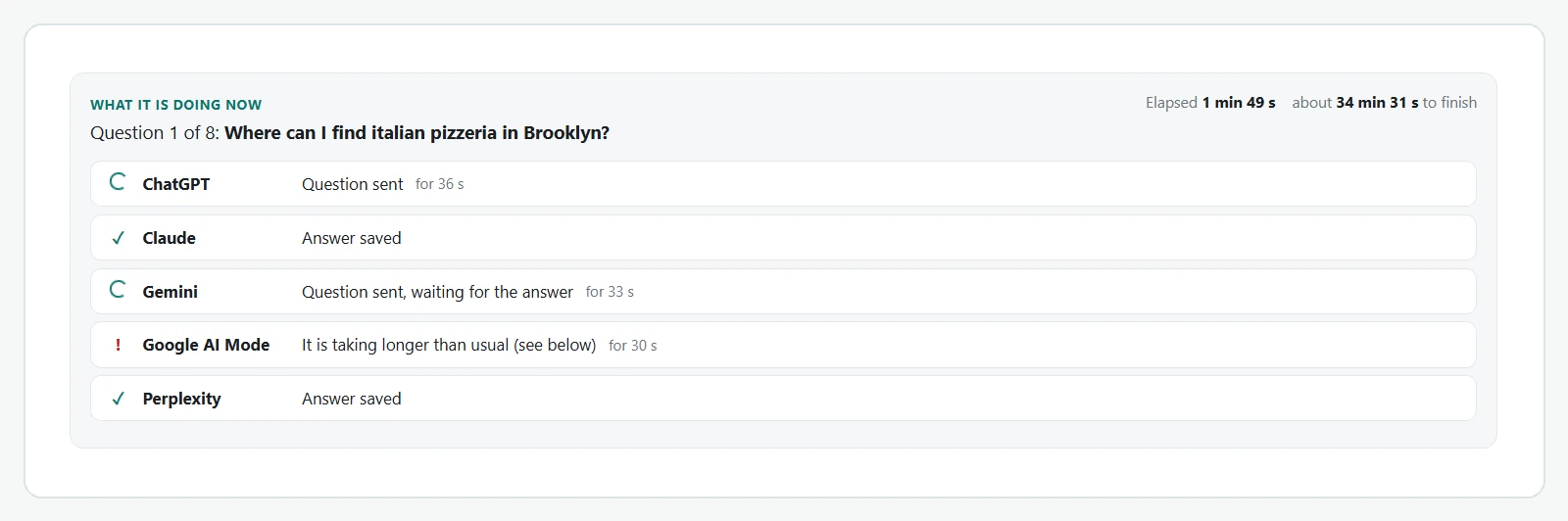
Tools that check LLM visibility, sometimes called LLM visibility checkers or LLM SEO checkers, work in one of two ways, and the difference matters more than the feature list.
API-based tools send your questions to the models through their developer APIs and run on their own. They scale well, but API answers can differ from what people see in the apps: different model settings, no signed-in context, sometimes no web search.
Browser-based tools ask the questions in the real apps, the way your customers do. The answers match what people actually read, at the cost of running in a browser rather than in the background. Our comparison of free LLM visibility checkers shows which tools work in which way and what each free plan includes.
Whatever the tool, keep in mind what Google itself points out: no third-party tool can see inside its ranking or AI systems, and the same is true for every AI platform. A tool can only read the answers. That is also the honest definition of LLM visibility: what the answers say, measured consistently over time.
QuotedBy is a browser-based checker that runs in your own Chrome. It types your questions on ChatGPT, Gemini, Claude, Perplexity and Google AI Mode, saves every answer with its sources and a dated screenshot, and turns them into a visibility rate, first mentions and a side-by-side view of your competitors. The free plan covers one project, 20 questions and all five platforms. See how it works for ChatGPT, Claude, Gemini, Perplexity and Google AI Mode, or start from the AI visibility score.
LLM visibility and LLM SEO
LLM SEO is the work of improving LLM visibility: the same practice also called GEO or AEO. Most of it builds on classic SEO, because AI platforms read search results, and adds three things: access for AI search crawlers, presence on the third-party pages AI cites, and content that answers questions clearly with facts and sources. Our guide on how to improve brand visibility in AI search turns that into a plan, how to rank in ChatGPT applies it to ChatGPT, and how to rank in Google AI Overviews covers Google's side.
How often to check
Weekly suits most brands: often enough to see a trend, rare enough to be sustainable. Check daily during a launch or a campaign, and monthly for a small local business. Whatever the rhythm, keep the questions and platforms the same, so each run is comparable with the last. When you change something, the before and after view shows whether your LLM visibility moved.
Frequently asked questions
What is LLM visibility?
It is how often and how well AI assistants such as ChatGPT, Gemini, Claude and Perplexity name your brand in their answers, measured as presence, position, share of voice, description and citations.
How do I check my brand's visibility in ChatGPT?
Ask ChatGPT a fixed set of questions your customers ask, record whether your brand appears and in what position, and repeat over time. A tool such as QuotedBy does it in your own browser and saves each answer.
What is the difference between a mention and a citation in LLMs?
A mention is your brand named in the text of the answer. A citation is a link to a page used as a source. An answer can mention your brand without citing your site, and cite your site without recommending your brand.
Is there a free LLM visibility checker?
Yes. QuotedBy's free plan checks one project with up to 20 questions on ChatGPT, Gemini, Claude, Perplexity and Google AI Mode, with no time limit.
Is LLM SEO different from SEO?
It builds on SEO and adds work on AI crawler access, presence on the pages AI cites, and measurement inside the answers. Our guide on GEO vs SEO covers the differences.