Share of voice (SOV) is your brand's part of all the visibility in a market, expressed as a percentage of the total for you and your competitors. If the brands in your category get 200 mentions in a month and 50 of them are yours, your share of voice is 25%. The idea is the same in every channel. What changes is what you count: ad spend, social mentions, press coverage, search traffic or, more recently, mentions in AI answers.
This guide covers the formula, how to measure share of voice in each channel, why it matters for growth, and how to measure it where it is newest and least understood: in the answers of ChatGPT, Gemini, Perplexity, Claude and Google AI Mode.
The share of voice formula
Every version of share of voice uses the same calculation:
Share of voice = your brand's measure ÷ the total measure of all brands in the set × 100
The measure depends on the channel, and so does the set of brands. Two choices decide whether the number means anything. First, define the competitor set and keep it stable: adding a brand halfway through changes everyone's share. Second, count the same thing for every brand, over the same period and in the same places.
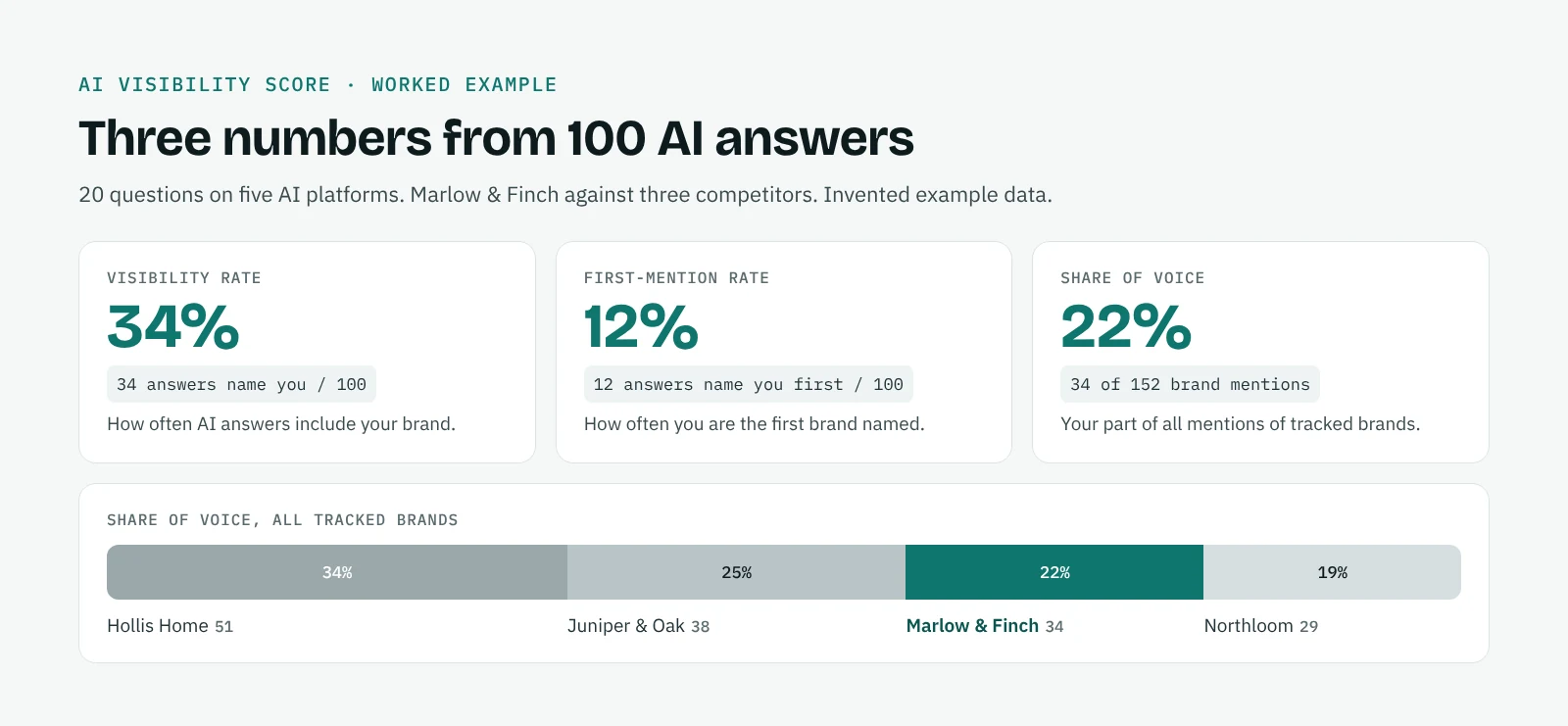
A worked example from AI search. Across 100 answers, four tracked brands are named 152 times in total: Hollis Home 51 times, Juniper & Oak 38, Marlow & Finch 34 and Northloom 29. Marlow & Finch's share of voice is 34 ÷ 152 × 100 = 22%.
Share of voice in each channel
| Channel | What you count | Where the data comes from |
|---|---|---|
| Advertising | Ad spend or impressions | Media plans, ad platforms, market research |
| Social media | Mentions of each brand | Social listening tools |
| PR and media | Articles or coverage that name each brand | Media monitoring |
| SEO | Estimated clicks or visibility on a set of keywords | Rank trackers and SEO suites |
| AI search | Mentions of each brand in AI answers to a set of questions | Answers collected from each AI platform |
In SEO, share of voice is one of the SEO KPIs worth reporting, next to clicks and conversions. The channels are not interchangeable. A brand can lead in advertising and be almost absent from AI answers, or the other way round. That is the main reason to measure each one separately.
Why share of voice matters
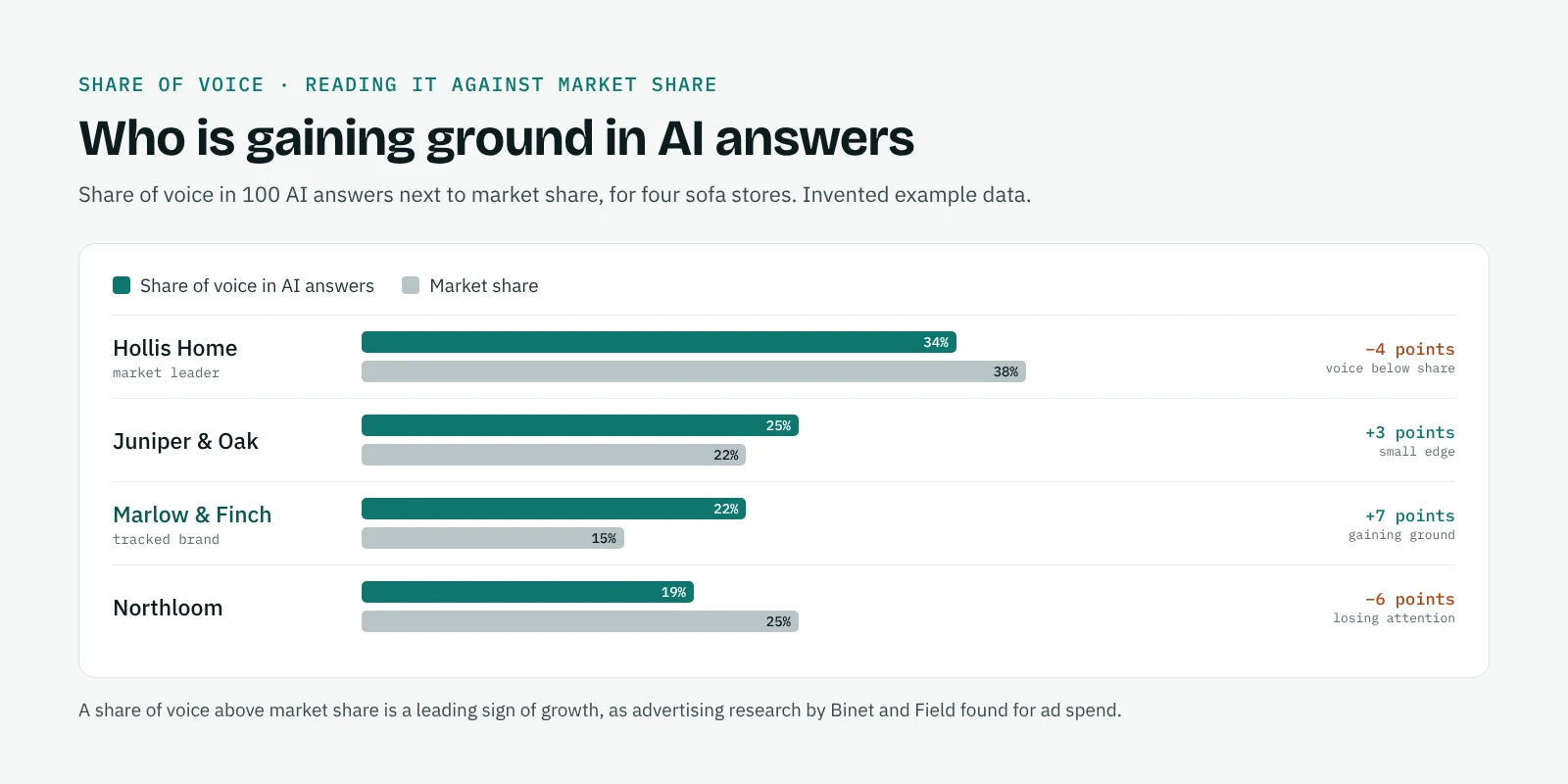
Share of voice is useful because it tends to lead market share. The best-known evidence comes from advertising research by Les Binet and Peter Field: brands whose share of voice is higher than their market share tend to grow, and for every 10 points of "excess" share of voice, market share grows by about half a point. The finding is about advertising spend, not AI answers, but the logic carries over: a brand that is mentioned more than its size suggests is gaining ground.
In practice, compare your share of voice with your market share. If they are close, you are holding position. If your share of voice is clearly lower, competitors are taking attention you will feel later in sales. A close cousin, share of search, measures the same idea on the demand side.
How to measure share of voice in SEO
Share of voice in SEO is usually calculated on a fixed set of keywords. A rank tracker estimates the clicks each domain gets from its positions, weighted by search volume and click-through rate, and divides each domain's total by the total for all domains in the set.
Two points matter. Search Console cannot do this, because it shows only your own site, so the numbers for competitors are always estimates. And the keyword set decides the result: keep it focused on the queries that bring customers, not every term you rank for.
How to measure share of voice in AI search
AI search has no rankings to weight and no public data, so share of voice is measured from the answers themselves. The method has four steps.
1. Choose neutral questions
Write 10 to 20 questions your customers ask, such as "best sofa store in Austin for a small apartment". Leave out questions that name your brand: they always mention you and inflate your share.
2. Ask them on each platform
Ask every question on ChatGPT, Gemini, Perplexity, Claude and Google AI Mode, with the same wording, and save each answer. Twenty questions on five platforms give 100 answers, a sample large enough to compare brands.
3. Count every brand named
For each answer, record every brand in your competitor set that appears. Then apply the formula: your mentions divided by all mentions of tracked brands. If you also note the order, you can add a second measure, the share of answers in which each brand is named first.
4. Repeat and compare
Run the same questions at regular intervals, weekly for most brands, and compare share of voice over time and by platform. A single run moves a lot because AI answers vary; a trend over several weeks is reliable. If you report to a client, share of voice belongs in the scorecard of a monthly AI visibility report.
Watch for brands outside your set. AI answers often name businesses you never considered competitors, and leaving them out makes everyone's share look larger than it is. Our page on the AI visibility score shows how share of voice sits next to the visibility rate and first-mention rate, and how to track brand mentions in AI search explains the method in more detail. To go from these numbers to who wins each answer and why, see our guide to AI competitor analysis. Share of voice is one of the five parts of LLM visibility.
QuotedBy collects the answers on all five platforms in your own Chrome and reads them for you. The overview puts each tracked brand's visibility side by side, platform by platform, so you can read your share of voice at a glance, and businesses the AI keeps naming that you do not track yet are flagged as possible competitors.
What is a good share of voice?
There is no universal number. A good share of voice is one that is equal to or higher than your market share, and growing. A newcomer with 5% of the market and 10% of the voice is doing well; a leader with 40% of the market and 25% of the voice is losing ground.
In AI search, compare platforms too. A brand can hold 30% on Perplexity and 8% on Gemini, and the gap usually points to the sources each platform relies on. Our guide on Google AI Overviews and AI Mode and the platform pages for ChatGPT, Perplexity and Gemini explain why.
How to increase your share of voice in AI answers
Share of voice in AI search rises when your brand appears on the pages AI platforms read and cite: reviews, lists, comparisons, directories and press. Start from the sources the answers already use, which our page on AI citation tracking explains how to collect. Our guide on how to improve brand visibility in AI search turns it into a plan, and the before and after view shows whether a change moved your share.
Frequently asked questions
What does SOV mean in marketing?
SOV stands for share of voice: a brand's part of all the visibility in its market, compared with competitors, measured as a percentage.
How do you calculate share of voice?
Divide your brand's measure (mentions, ad spend, clicks or AI answer mentions) by the total for all brands in your competitor set, then multiply by 100.
What is the difference between share of voice and market share?
Market share measures sales; share of voice measures visibility. Research on advertising shows that brands whose share of voice exceeds their market share tend to grow.
Is share of voice a useful SEO metric?
Yes, as long as the keyword set reflects the queries that bring customers. It shows how you compare with competitors, which rankings alone do not.
Can I measure share of voice in ChatGPT?
Yes. Ask ChatGPT a fixed set of neutral questions, count every brand named in the answers, and divide your mentions by the total. Repeat over time and on other AI platforms to compare.