Share of search is your brand's part of all the searches for brands in your category: searches for your brand, divided by searches for all the brands you compete with. If people search for the five main sofa stores in your city 10,000 times a month and 2,000 of those searches are for you, your share of search is 20%. It starts from the same data as branded search, extended to your competitors.
The metric was popularized by Les Binet, who presented it in 2020 at EffWorks, the effectiveness conference of the UK's Institute of Practitioners in Advertising (IPA). Its appeal is that it is free, fast and, according to his analysis, tends to predict market share. This guide explains how to calculate it with Google Trends, how to read it, and why it matters more now that AI answers recommend brands without a click.
Why share of search predicts market share
People search for brands they are considering. A rising share of search means more people have your brand in mind, and that usually shows up in sales later. Binet tested the idea in three categories, cars, energy and mobile phones, and found share of search correlated with market share in all of them. It also moved first: in cars, changes in share of search could anticipate changes in market share by up to a year, making it an early warning signal when a brand starts losing ground.
It is not a perfect predictor. Price, distribution and the quality of the product decide how many searches turn into sales. Treat it as a leading indicator of interest, not a forecast of revenue.
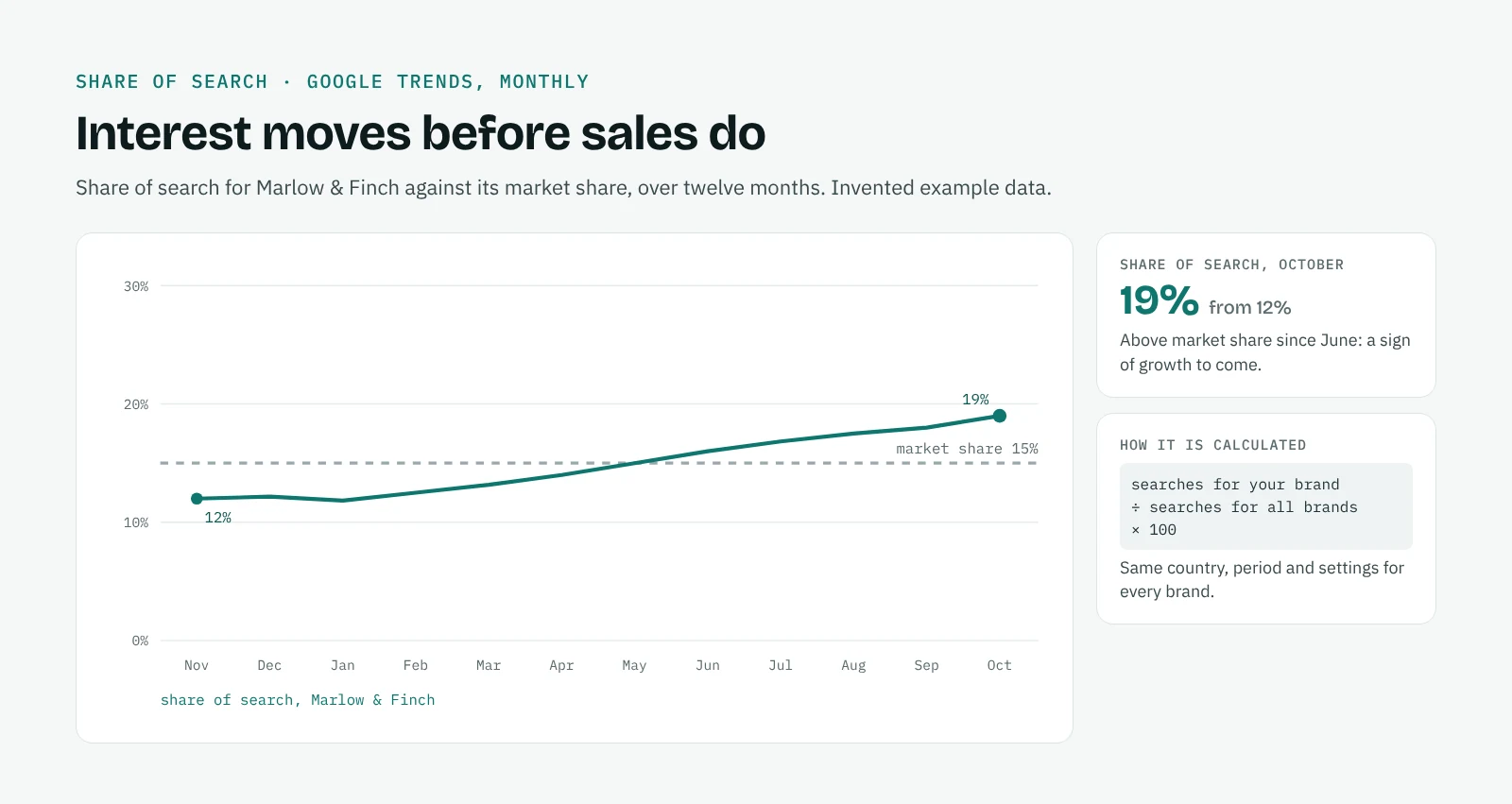
How to calculate share of search
1. List the brands in your category
Include every brand a customer would consider, not only the ones you like to compare yourself with. Keep the list stable over time.
2. Collect search interest in Google Trends
Enter the brand names in Google Trends, set the country and the period, and choose the search category if a brand name is ambiguous. Where Google Trends offers the brand as a topic rather than a search term, the topic groups spelling variants together. Google Trends compares up to five terms at a time and shows each as a relative value from 0 to 100, so if you have more than five brands, keep one brand in every comparison as an anchor and rescale the others against it.
3. Apply the formula
Add up each brand's values over the period and divide by the total for all brands:
Share of search = searches for your brand ÷ searches for all brands in the category × 100
Weekly or monthly values work; what matters is using the same period and settings for every brand.
4. Track it over time
One number tells you little. A monthly series over at least a year, compared with your market share, shows whether you are gaining or losing interest and how fast.
Share of search tools
Google Trends is enough to start, and it is free. SEO suites add keyword volumes, which are easier to read than relative values but are estimates and update more slowly. Search Console helps on your side only: with its branded queries filter you can see your own branded searches in detail, but not your competitors'. Our guide on branded search covers that part.
How to read share of search
Compare share of search with market share. If it is higher, your brand attracts more interest than its sales, and growth is likely to follow; if it is lower, you are living on past demand. Then look at turning points: a sudden change usually has a cause you can find, such as a campaign, a product launch, press coverage or a competitor's move.
Add a new possible cause to that list: AI answers. When ChatGPT, Perplexity or Google AI Mode start naming a brand more often for the questions buyers ask, some of those readers search for it by name. Share of search is where that shows up first, before any click is recorded.
Share of search and share of voice in AI answers
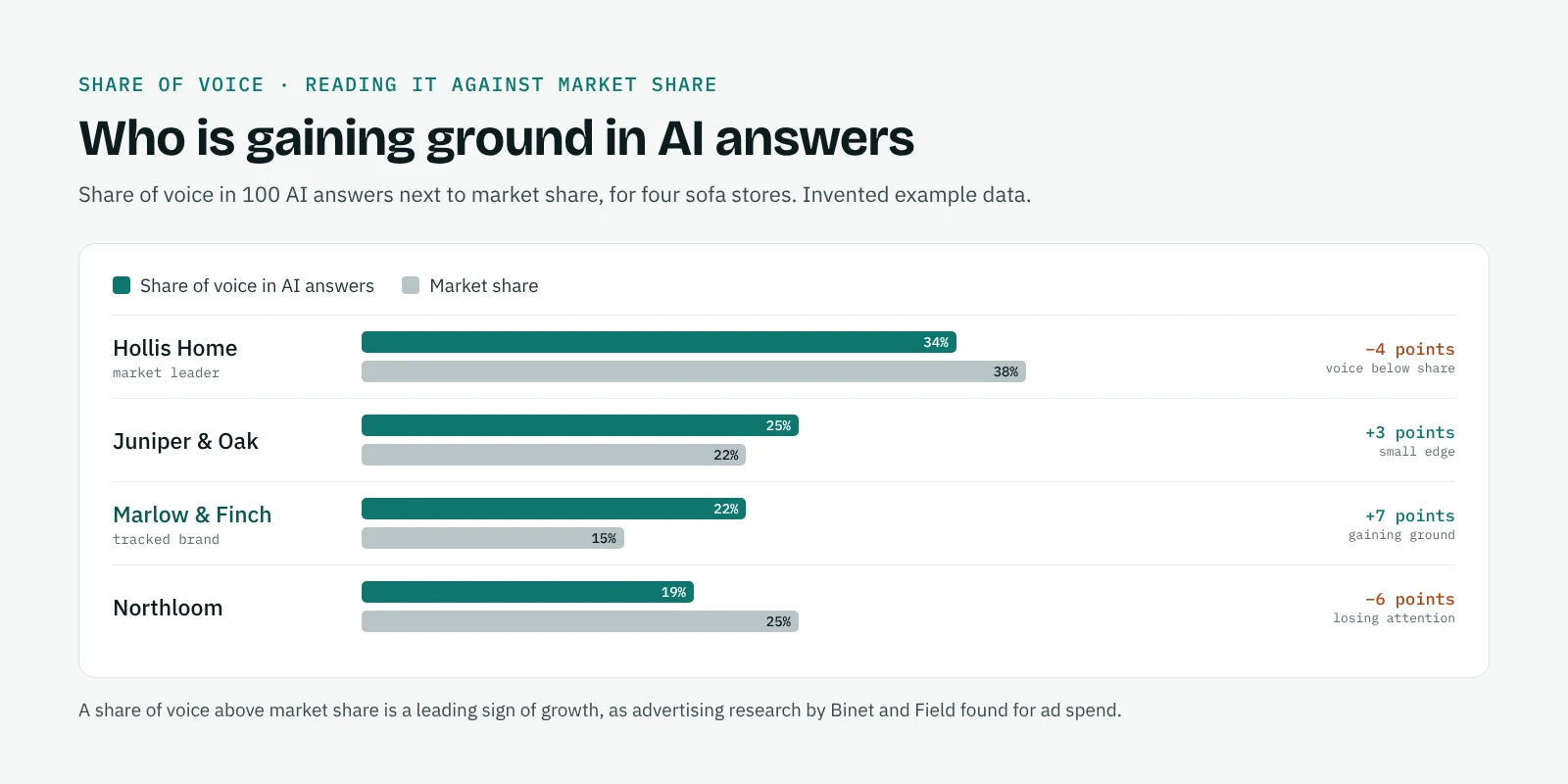
Share of search measures demand: how many people look for you. Share of voice measures visibility: how often you are named compared with competitors, and in AI search it is measured from the answers themselves. Reading the two together tells you more than either alone. A brand with a high share of voice in AI answers and a flat share of search is being named but not remembered; a brand whose share of voice rises before its share of search is building demand through AI.
QuotedBy measures the AI side. It asks your customers' questions on ChatGPT, Gemini, Perplexity, Claude and Google AI Mode on a schedule, in your own Chrome, and shows how often each brand is named. Our page on the AI visibility score explains the numbers, and how to measure GEO results shows how to compare them over time.
Frequently asked questions
What is share of search?
Your brand's share of all searches for brands in your category, calculated as searches for your brand divided by searches for all the brands you compete with.
Who created share of search?
The metric was popularized by Les Binet, who presented it at the IPA's EffWorks conference in October 2020.
How do you calculate share of search?
Collect search interest for every brand in your category, for example in Google Trends, add up each brand's values over the same period, and divide your brand's total by the total for all brands.
Is share of search the same as share of voice?
No. Share of search measures how often people search for your brand; share of voice measures how often your brand is shown or named, in ads, media or AI answers.
Is there a free share of search tool?
Google Trends is free and enough to calculate share of search for up to five brands at a time, or more with an anchor brand.