Ask ChatGPT for the best option in your category and it will usually name a few brands, explain why, and move on. If yours is not one of them, someone else got the recommendation. AI competitor analysis is the work of finding out who that someone is, on which questions and platforms, and why the assistant trusts them more than you.
This is not the same thing as using AI to analyse competitors, which is what most articles with this title cover: pasting a rival's website into a chatbot and asking for a SWOT. Here the AI answers are the market you are studying. The method below works by hand with a spreadsheet, and the last section shows where a tracker saves time.
Your AI competitors are not always your Google competitors
In classic search, your competitors are the domains that rank next to you. In an AI answer there is no list of ten results: there is a short recommendation, often three to five brands, built from what the model learned in training and from the pages it searched for that question. Two things follow.
The first is that the set of competitors changes. A brand with weak SEO can be named often because review roundups, forums and comparison articles mention it, and a strong SEO competitor can be missing because its pages say little that an assistant can quote. The second is that each platform has its own list. ChatGPT, Gemini, Perplexity, Claude and Google AI Mode search different sources and weigh them differently, so the brand that wins on one may barely appear on another. That is why the analysis starts from the answers, not from the competitor list you already have. There is more on how the platforms differ in our guide to LLM visibility.
How to run an AI competitor analysis
The method has five steps, and it is the same whether you do it in a spreadsheet or with a tool.
- Pick the questions your buyers ask. Start with 15 to 30 questions where a recommendation is the natural answer: "best [product] for [use]", "[product] for [type of customer]", "alternatives to [market leader]", "[brand A] vs [brand B]". Write them as a person would type them, and keep the list fixed so the results stay comparable over time.
- Ask them on each platform, in the same conditions. Use the same wording, the same country and, where possible, a clean session, because personal memory and past chats can change an answer. Run each question on every platform you care about. One run is a sample, not a verdict: answers vary from one run to the next, so the trend over several runs is what you report.
- Record who is named, in what order, and from which sources. For every answer, note each brand mentioned, which one comes first, and the pages the assistant cited. This is where most new competitors show up: names you never tracked that keep appearing next to the market leaders.
- Turn the answers into numbers. Three metrics are enough. Visibility rate is the share of answers that name a brand. First-mention rate is the share of answers where it is named first. Share of voice is a brand's mentions divided by the mentions of all the brands you track. Our guide to share of voice explains the calculation, and the AI visibility score page shows how the same figures look in QuotedBy.
- Repeat on a schedule. Monthly is enough for most markets, weekly when you are actively changing pages or running PR. The first run is your baseline; every later run tells you whether the gap is closing.
Competitor benchmark analysis: reading the table
Once the numbers are in, put every brand in one table, one row each, with the same columns. The table below is the kind of benchmark you get after one month for an invented furniture brand, Marlow & Finch, against three tracked competitors.
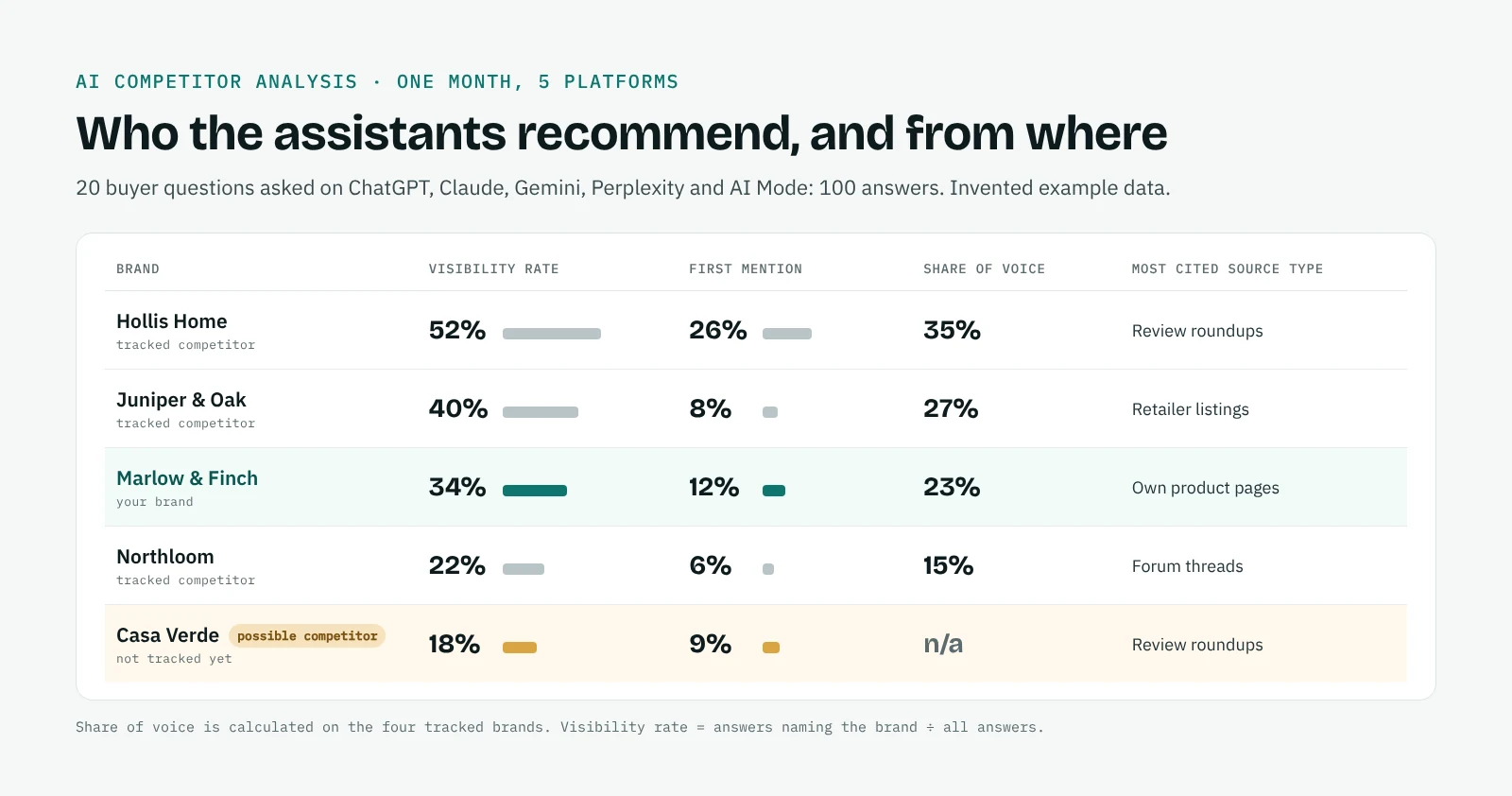
The headline is rarely the visibility rate alone. In this example Hollis Home leads on every metric, but the more useful line is the source column: most of its mentions come from review roundups that Marlow & Finch does not appear in. Juniper & Oak is named more often than Marlow & Finch but first less often, which usually means it is listed as an alternative rather than recommended. And Casa Verde, a brand nobody on the team was tracking, appears in 18 answers. A competitor benchmark analysis is worth doing for that last row alone: it is the brand the assistants already treat as your competitor.
Read the table per platform too. A brand that leads overall may owe it to one assistant, and a gap that exists only on Perplexity points to the sources Perplexity searches, not to your whole content strategy. When this benchmark goes to a client every month, it becomes the competitors section of a monthly AI visibility report.
How to track competitor mentions in AI Overviews and AI Mode
Google's two AI features need a separate note, because the data you can get differs.
AI Mode works like the other assistants: you ask a question, it writes an answer with sources, and you can record the brands it names. QuotedBy tracks it, and it is the one platform where the monitoring starts on its own without you pressing Enter. The AI Mode tracker page has the details.
AI Overviews appear only for some queries, can change between one search and the next, and are not tracked by QuotedBy. The practical approach is a short list of high-value queries checked by hand, with a screenshot each time, noting which brands and sources the overview shows. Search Console will not fill the gap for competitors: its Generative AI report shows impressions for your own pages only, with AI Overviews and AI Mode counted together. Our guide on how to rank in Google AI Overviews covers what you can influence there.
Why AI recommends a competitor instead of you
When you look at the sources behind the answers that name a competitor and not you, the reasons tend to fall into four groups.
A source gap. The assistant searched, found three review articles, and those articles list your competitor and not you. This is the most common reason and the most fixable one: the pages exist, you can see them, and you can work on being included. The AI citation tracking page explains how to find them.
A content gap. The question asks something your site never answers directly, such as a comparison, a use case or a price range, while the competitor has a page that does. Assistants quote pages that state facts clearly; the research behind GEO found that adding statistics, quotations and sources to a page raised its visibility in generated answers, while keyword stuffing did the opposite.
A positioning gap. The assistant does not know what you are for. If your own pages, your listings and third-party mentions describe you in different ways, the model has no clear reason to recommend you for a specific need. Competitors that are named for one clear thing tend to win the "best X for Y" questions.
A trust gap. Some competitors are simply better known: more reviews, more press, more years in the market. This one closes slowly, and the honest answer is that no page edit fixes it on its own.
What to do about it
Start from the gap with the biggest effect on the questions that matter most, not from the competitor you dislike most. For a source gap, list the pages cited when the competitor is named and work on getting into them with real reasons: an update to a review, a product sent for testing, data the author can use. For a content gap, write the page the question needs, on your own site, in plain language. For a positioning gap, make the way you describe yourself consistent everywhere you control it.
Two things are not worth doing. Google's guidance for its AI features is explicit that there is no special optimisation beyond good SEO, and it lists inauthentic mentions among the tactics to ignore. Planting your brand in forums or buying placements on listicles may move one answer for a while, but it is the kind of signal search systems are built to discount. Our guide on how to improve brand visibility in AI search goes through the work in order.
After each change, rerun the same questions and compare. QuotedBy's before and after view does this for one action at a time, so you can tell which change moved the numbers.
Tools to benchmark AI SEO performance against competitors
A spreadsheet works for a first pass: twenty questions, five platforms and four brands is a hundred answers to read and record. It becomes hard to keep up when you want to repeat it every month and compare runs, which is where a tracker helps.
QuotedBy runs your questions in your own Chrome on ChatGPT, Claude, Gemini, Perplexity and Google AI Mode, records the brands named and the sources cited in each answer, and shows your visibility next to your competitors'. Brands that the assistants mention but you are not tracking are flagged as possible competitors, so the Casa Verde row above is found for you. The free plan includes one project, three competitors, twenty questions and 90 days of history, and the answers stay in your browser. It does not track AI Overviews or Copilot.
Other tools take different approaches, from one-off free checks to paid trackers with larger question sets. We compared them, with their limits and prices as of October 2026, in the best free AI rank trackers.
Frequently asked questions
What is AI competitor analysis?
It is the analysis of which competitors AI assistants such as ChatGPT, Gemini, Perplexity, Claude and Google AI Mode recommend for the questions your buyers ask, how often, and based on which sources. The term is also used for analysing competitors with AI tools, which is a different task.
How do I find out which competitors ChatGPT recommends?
Ask ChatGPT the questions your buyers ask, in a clean session, and record every brand named and every source cited. Repeat each question more than once, because answers vary, and track the results over time rather than relying on one run.
Can I track competitor mentions in Google AI Overviews?
Only by checking the queries yourself or with a tool that covers AI Overviews. Search Console's Generative AI report shows impressions for your own pages, not for competitors, and QuotedBy tracks AI Mode but not AI Overviews.
How many competitors should I track?
Three to five is enough for most brands: the ones you lose deals to, plus the ones the assistants name most often. Add a new one when it keeps appearing in the answers.
How often should I run an AI competitor analysis?
Monthly for a stable market, weekly while you are changing pages or running campaigns. Keep the same questions and platforms each time so the numbers can be compared.