Is it possible to track brand mentions in AI search? Yes, but not the way you track rankings. Ask ChatGPT the same question twice and you may get two different lists of brands. That makes a single answer almost worthless as a measurement. What does hold up is how often a brand appears across many answers, which sources the assistants cite, and how that changes over the months.
This guide takes the doubt seriously. It explains why AI visibility looks unmeasurable, what you can measure reliably anyway, what no tool can see, and how AI monitoring tools actually work, so you can judge any number you are shown, including ours.
Why AI visibility looks impossible to measure
The skeptics have a point. Three things make AI answers harder to measure than a page of search results.
The same question gets different answers. Language models pick their words with some randomness, and assistants that search the web may find different pages from one run to the next. A study by SparkToro and Gumshoe ran the same brand recommendation prompts thousands of times on ChatGPT, Claude and Google's AI: ChatGPT and Google returned the same list of brands less than 1% of the time, and the same list in the same order less than 0.1% of the time.
Every user sees a slightly different assistant. Memory, past chats, location and the model version all shape the answer. A tracking account is not your customer's account. Our guide on why ChatGPT gives different answers to the same question goes through each factor.
Nobody outside the AI companies knows the real questions. There is no Search Console for ChatGPT. You can't see which questions people ask, how often, or what they were shown. Any tracking starts from a set of questions you chose.
None of this means there is nothing to measure. It means the unit of measurement is not one answer.
What you can measure reliably
The same SparkToro study found something more useful than the noise. Even when every answer was different, some brands kept coming back: for headphones, Bose, Sony, Sennheiser and Apple appeared in 55% to 77% of almost a thousand answers to prompts written by different people. Presence across many answers is stable; position in a single answer is not.
That gives you a short list of metrics that hold up, and a few that don't.
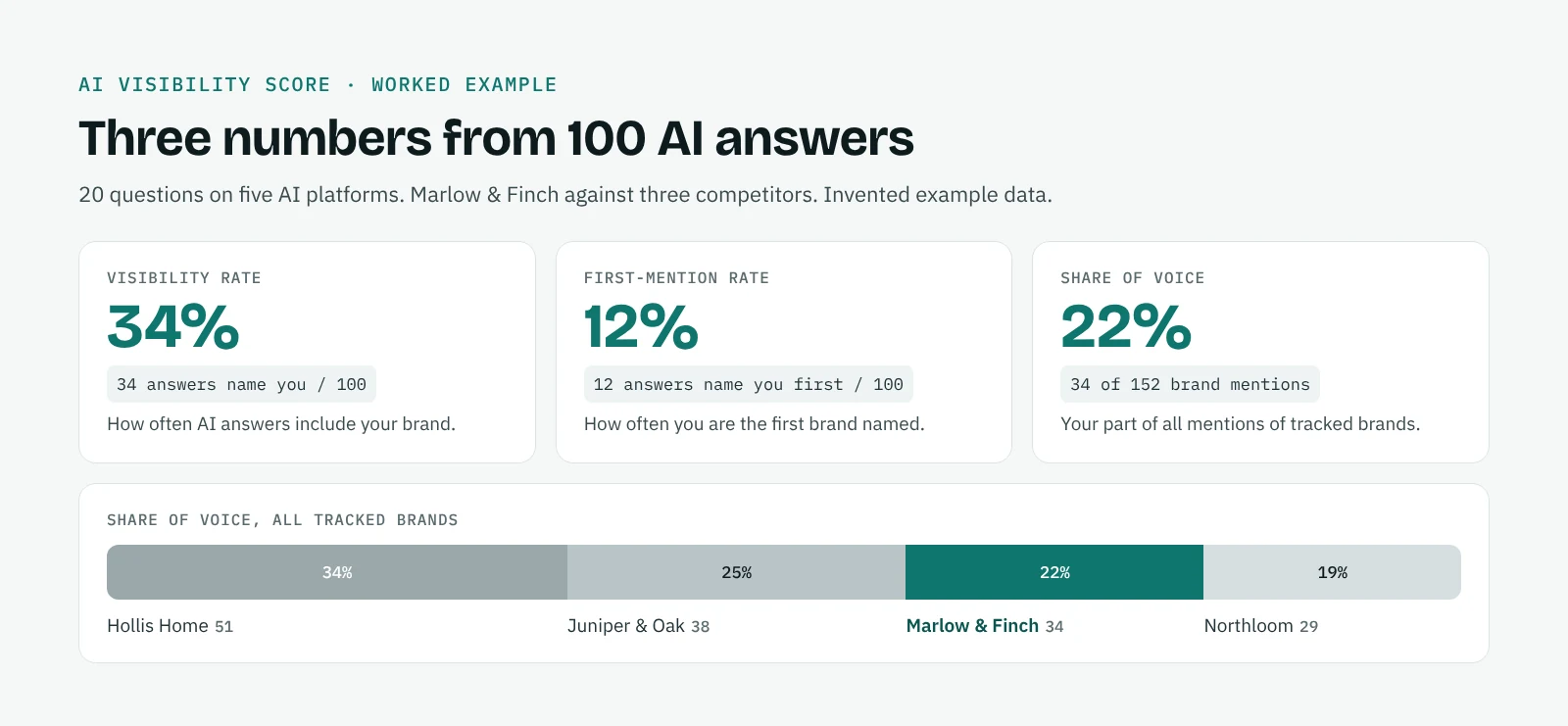
| Metric | How stable | Use it for |
|---|---|---|
| Visibility rate: share of answers that name the brand | Stable over many answers | The headline number and its trend |
| Share of voice: the brand's mentions against all tracked brands | Stable over many answers | Comparing the brand with competitors |
| Cited sources: pages the assistants link to | Fairly stable for the leading sources | Finding pages to work on |
| How the brand is described | Stable in substance, not in wording | Spotting wrong or outdated information |
| First-mention rate | Noisier than visibility | A secondary signal, read over several months |
| Position in one answer | Not stable | Nothing. Don't report it |
Our page on the AI visibility score defines each metric and how to calculate it.
How many answers make a number
A visibility rate is a share, so it has a margin of error that shrinks as answers add up. As a rough guide, with 100 answers a rate of 34% could really be anywhere between about 25% and 43%. With 400 answers the range narrows to about 29% to 39%.
In practice: 20 questions on five platforms give 100 answers per run. Four weekly runs give 400 answers a month. That is enough to take seriously a change of more than about seven points from one month to the next, and not enough to celebrate two points in a week. Answers to related questions are not fully independent, so treat these ranges as a floor, not a precise figure.
What no tool can measure
Be wary of any tool that claims to show the following.
- Real questions and their volume. AI companies don't publish what people ask. "Prompt volumes" are estimates built from other data.
- Why the model chose a source. You can see which pages are cited and test what changes after you act. You can't read the model's reasons.
- What one specific customer saw. Their memory, history and location are theirs.
- Every exposure to your brand. Most people who read a recommendation don't click. GA4 sees only the visits: our guide to tracking AI traffic in GA4 shows what the AI Assistant channel captures and what it misses. For Google's AI features, the Search Console Generative AI report counts impressions of your pages, not mentions of your brand.
Google states in its guidance on AI features that no third-party tool has access to its internal systems. AI visibility tracking is an observation of answers to your questions, not an official metric. That is what it should be presented as.
Why use AI search monitoring tools at all
If the numbers are approximate, why bother? Because the alternative is guessing, and four things are hard to get any other way.
Competitors. The answers show who is recommended in your place, including brands nobody on the team considered a competitor.
Sources you can act on. When a review roundup or a directory is cited in many answers and doesn't list your brand, that is a concrete task. See AI citation tracking for how to collect them.
Wrong information. Questions that name your brand show how the assistants describe it: old prices, a closed location, a product you no longer sell.
Evidence for decisions. A trend over three months, with the answers saved, tells you whether the work you did changed anything. A client or a manager can check it.
How AI monitoring tools work
Every AI search monitoring platform does the same four things, whatever the dashboard looks like.
- A fixed set of questions. You choose them, or the tool suggests them. This is the biggest decision you make: our guide on how to choose prompts to track AI visibility covers it.
- Runs on each platform. The questions are sent to ChatGPT, Gemini, Perplexity and the others, once or several times, on a schedule.
- Reading the answers. The tool finds the brands named, their order, the links and how each brand is described.
- Aggregation. The answers become rates, shares and trends.
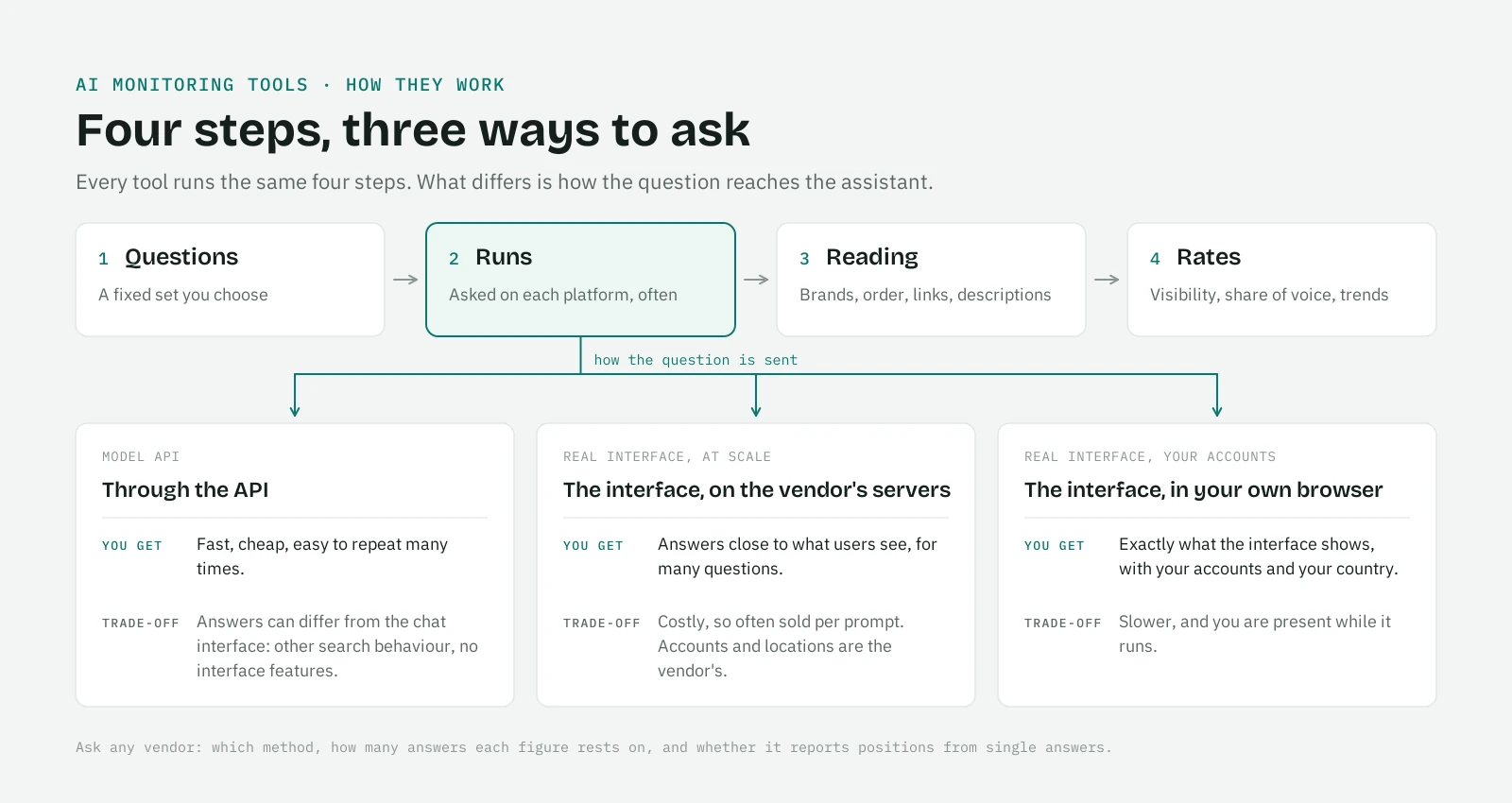
The real difference between tools is in step 2: how the question reaches the assistant.
| How the question is sent | What you get | Trade-off |
|---|---|---|
| Through the model's API | Fast, cheap, easy to run many times | API answers can differ from what users see in the chat interface, with different search behaviour and no interface features |
| Through the real interface, run on the vendor's servers | Answers close to what users see, at scale | Expensive, so usually sold per prompt; the accounts and locations are the vendor's |
| Through the real interface, in your own browser | Exactly what the interface shows, with your accounts and your country | Slower, and you are present while it runs |
None of these is wrong. Ask any vendor which one it uses, how many runs each figure rests on, and whether it reports positions from single answers. The answers tell you how much to trust the numbers. For a comparison of free options, see the best free AI rank trackers.
How to make the numbers trustworthy
A few habits turn noisy answers into a measurement you can defend.
Keep the question set stable. Changing the questions changes the series. Add or retire questions once a quarter, and mark the change.
Track many questions, not a few. Twenty questions on five platforms beat five questions asked twenty times: you measure the topic, not one wording.
Run on a schedule. Weekly runs, reported monthly, give each figure hundreds of answers.
Keep the conditions the same. Same accounts, same country, same language, memory settings unchanged between runs.
Read trends against the baseline. The first month you measured is the reference. A steady rise over a quarter is a result; one good week is not.
Keep the evidence. Save the answers with their dates and sources, so every number can be checked.
Once you are convinced, our page on how to track brand mentions in AI search walks through the setup step by step.
Tracking brand mentions with QuotedBy
QuotedBy is a Chrome extension that runs your questions in your own browser on ChatGPT, Claude, Gemini, Perplexity and Google AI Mode. It types each question, you press Enter (Google AI Mode starts on its own), and it saves every answer with its sources and a screenshot. Each run asks every question once on each platform, so the reliable figures are the rates over many answers and their trend from run to run, which is how QuotedBy shows them.
It computes visibility per question and per platform, shows who is named first, lists the cited sources page by page, compares each run with the previous one, and flags brands the assistants mention that you are not tracking. Reminders (daily, weekly or monthly) keep the schedule.
The free plan covers one project, three competitors and 20 questions on all five platforms. Pro, at 24 € a month, raises the limits and adds the built-in AI analysis without setup. QuotedBy does not track AI Overviews or Copilot.
Frequently asked questions
Is it possible to track brand mentions in AI search?
Yes. You can't get a stable position in a single answer, but you can measure how often a brand appears across many answers to a fixed set of questions, which competitors appear instead and which sources are cited. Those figures are stable enough to follow over months.
Is it possible to monitor brand mentions in AI search for free?
Yes, by hand with a spreadsheet, or with a free tool. QuotedBy's free plan tracks 20 questions on ChatGPT, Claude, Gemini, Perplexity and Google AI Mode for one project.
Why do AI visibility numbers change from week to week?
Because each answer is generated again, with some randomness, and the sources found by web search change. Small weekly changes are mostly noise; read the trend over a month or a quarter.
Can I see how many people ask ChatGPT about my brand?
No. OpenAI does not publish what users ask. GA4 shows the visits that come from ChatGPT links, not the conversations that mention you without a click.
Should I report my brand's position in ChatGPT?
No. Position changes in almost every answer. Report the visibility rate, the share of voice and the sources, with their trend.