More and more people ask an assistant about a business before they visit its website. "Is Marlow & Finch good quality?", "Do they deliver to Ireland?", "How much is their oak table?". The answer is your AI brand reputation: what ChatGPT, Gemini, Perplexity, Claude and Google AI Mode tell people about you. Sometimes it is wrong.
This guide is about that reputation, inside AI answers, rather than about using AI tools to manage reviews. It shows why assistants get businesses wrong, how to find where an error comes from, how to fix it at the source, how to report the answer, and how to keep checking.
Why AI gets brands wrong
How often is ChatGPT wrong? Nobody can give a number for your brand, and the AI companies don't claim perfection either: ChatGPT shows a warning that it can make mistakes, and Google says its AI Overviews can and will make mistakes. For a business, the errors usually come from one of five places.
| What the answer gets wrong | Likely cause | Where to look |
|---|---|---|
| Old prices, products or opening hours | Training data from before a change, or an old page still online | Your old pages, PDFs, marketplace and directory listings |
| A location that closed or never existed | Directory and map listings, old press | Local listings, directories, news archives |
| Your brand mixed up with another | Similar names, thin information about you | Search results for your name, the other company's pages |
| An old complaint presented as current | Reviews and forum threads that still rank | Review sites, forums, news |
| Vague or invented details | Too little clear information about you on the web | Your own site first |
The common thread: assistants repeat what they find or what they learned. An answer based on web search follows the pages it cites. An answer from training data repeats what the web said before the model's cutoff. Our guide to where ChatGPT gets its information explains the two.
Step 1: find out what the assistants say about you
Write five to ten questions that name your brand, the way a customer would:
- What is [brand] and what does it sell?
- Is [brand] good? Is it reliable?
- How much does [brand]'s [main product] cost?
- Where is [brand] and when is it open? (or: do they deliver to [country]?)
- [brand] or [main competitor]: which is better?
- What do customers say about [brand]?
Ask each one on ChatGPT, Gemini, Perplexity, Claude and Google AI Mode, in a new chat with memory off (in ChatGPT, a Temporary Chat). Save the answers with the date. Ask again on another day before reacting: answers change from one run to the next, and one odd answer can be a fluke. Our guide on whether ChatGPT gives the same answers to everyone explains why.
An error that comes back across runs, or on several platforms, is the one to fix.
Step 2: find where the error comes from
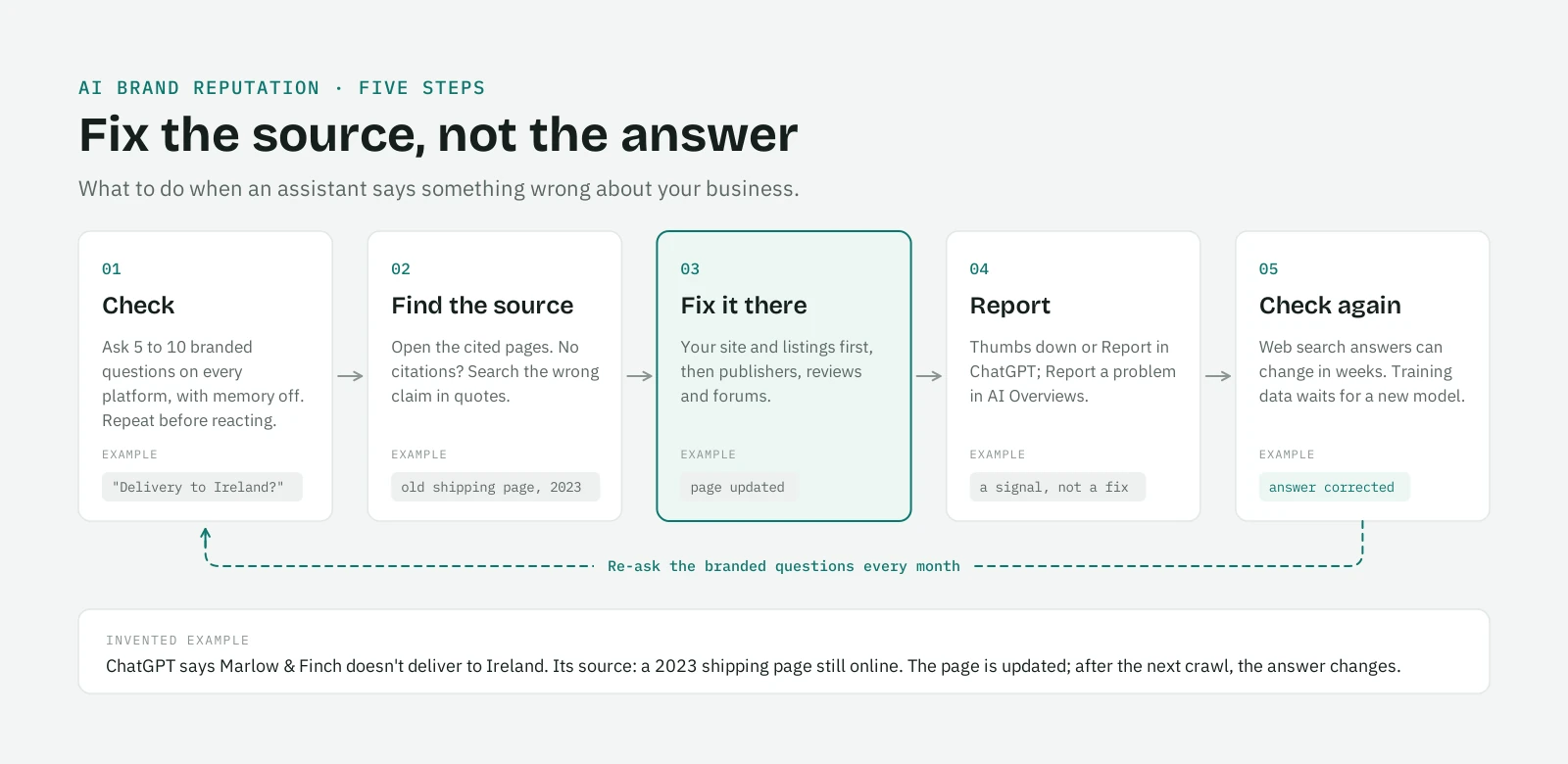
If the answer cites sources, open them. The wrong price or the closed address is often right there, on a directory, a marketplace listing or an old article.
If it cites nothing, the error probably comes from training data. Search for the wrong claim on Google, in quotes, to find the pages that still repeat it. Check your own site too: an old product page, a PDF price list from three years ago or a forgotten landing page can be the source.
If two companies are mixed up, search for your name alone and see what comes up. The assistant is probably reading pages about the other company.
Step 3: fix it at the source
You can't edit an AI answer. You can fix the pages it relies on, and the answers follow.
Your own site. State the key facts in plain sentences on pages that are easy to find: what you sell, where, prices or price ranges, delivery areas, opening hours, who runs the business. Update or redirect outdated pages and remove old documents with wrong prices. Structured data such as Organization markup on your home page helps search engines identify your name, logo and contact details, but the visible text is what matters most.
Listings you control. Your Google Business Profile, directories, marketplace listings and review platform profiles. These are frequent sources for factual questions about a business.
Pages you don't control. Ask the publisher of an article to correct an outdated fact, with the evidence. Reply publicly to old reviews that describe a problem you have fixed. In forums, an honest answer from your team, clearly signed, can correct a thread without looking like advertising.
When there is too little about you. Assistants fill gaps. More clear, consistent information about the business on your site and on the sources assistants already cite is the remedy. Our guide on how to improve brand visibility in AI search covers how to get onto those sources.
Step 4: report the wrong answer
Reporting doesn't correct the answer directly, but it tells the provider something is wrong.
ChatGPT. Where is the option on ChatGPT to give feedback? Under each response: the thumbs-down icon, or Report to flag content. OpenAI has retired its old feedback form and points to these two options instead. Add a short note with the correct information.
Google AI Overviews. At the bottom of the overview, click thumbs down, then Report a problem, choose the category and describe the error.
Gemini, Perplexity and Claude have their own feedback options next to each answer, usually a thumbs-down with room for a comment.
If the wrong information is about a person rather than a company, data protection rules may give that person further options; check the provider's privacy page.
Step 5: check again
Answers based on web search can change within weeks of fixing the source, as soon as the corrected page is crawled and found again. Errors that come from training data can last until a new model is released. Re-ask the same questions every month, on every platform, and keep the dated answers: they show when the fix worked, and they are the evidence if a client or a manager asks.
Make brand reputation part of your AI tracking
Checking once is not enough: a new review, a changed listing or a new model can bring an error back. Keep the branded questions in your regular tracking, as a separate group from the questions that measure visibility, and review their answers every month. Our guide on how to choose prompts to track AI visibility explains why the two groups must stay apart. For an agency, a short "what the assistants say about you" section in the monthly report is often the part the client reads first: our AI visibility report template shows where it fits.
This is reputation monitoring for a new channel. Classic brand reputation monitoring tools watch reviews, social media and news; they don't read what the assistants answer.
Monitoring AI brand reputation with QuotedBy
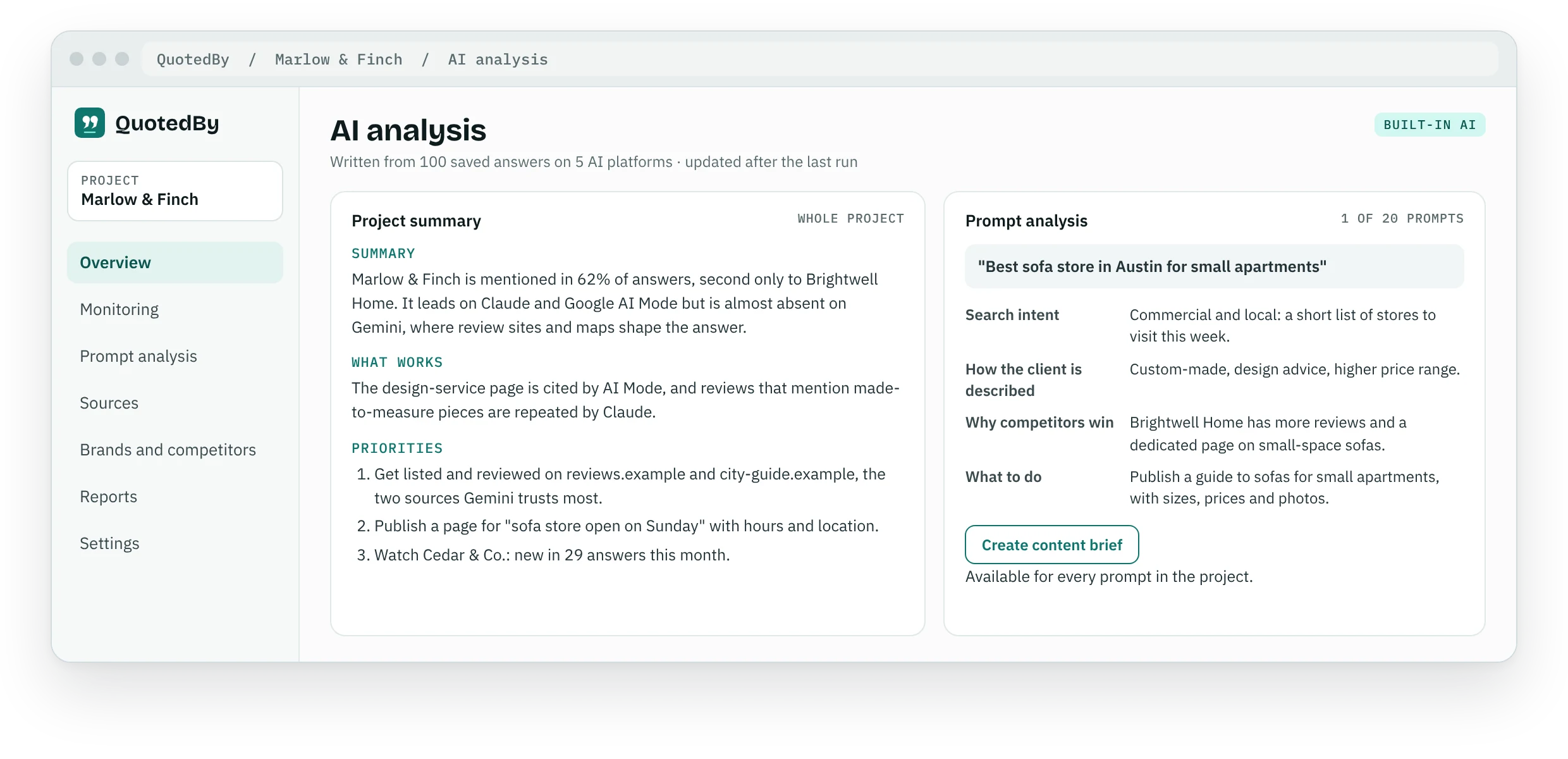
QuotedBy runs your questions, branded ones included, in your own Chrome on ChatGPT, Claude, Gemini, Perplexity and Google AI Mode. It saves every answer with its sources and a screenshot, so you can see what each assistant said and which page it relied on. The AI analysis of each question summarises what the answers say, and for questions that name your brand the content brief aims at a correct description of the business, not at being cited more. Each run is compared with the previous one, so a new error shows up as a change.
The free plan covers one project, three competitors and 20 questions on all five platforms. Pro, at 24 € a month, adds alerts at the end of a run and the before and after view, which shows whether a fix changed the answers. Our page on how to track brand mentions in AI search covers the setup.
Frequently asked questions
What is AI brand reputation?
It is what AI assistants such as ChatGPT, Gemini, Perplexity, Claude and Google AI Mode say about a business when people ask about it: how they describe it, what they get right and what they get wrong.
Can I ask OpenAI to correct what ChatGPT says about my business?
Not directly. You can report an answer with the thumbs-down icon or Report, but the reliable fix is to correct the pages ChatGPT relies on: your site, listings, directories and articles.
Where is the option on ChatGPT to give feedback?
Under each response: the thumbs-down icon, or Report to flag content.
How often is ChatGPT wrong about businesses?
There is no general figure. Errors are more likely for small businesses with little information online, for recent changes, and for names similar to other companies.
How long does it take for a fix to show up in AI answers?
For answers based on web search, often a few weeks after the corrected page is crawled. For answers from training data, it can take until a new model is released.