ChatGPT gets its information from two places. What it learned during training, from a large body of text collected before a cutoff date, and what it finds when it searches the web, at the moment you ask. A third, smaller layer is what it knows about you, if memory is on.
For a brand, the difference matters. Training data is slow and can't be edited. Web search is fast, cites its sources, and depends on pages you can find and often influence. This guide explains both, then shows how to find the pages ChatGPT cites for your topic, including the ones that recommend your competitors.
Where ChatGPT gets its data: training
OpenAI describes three sources for the data its models learn from. According to OpenAI, they are:
- Information publicly available on the internet, such as public web pages, forums and blogs. Paywalled content and the dark web are excluded.
- Information from third-party partners, such as datasets obtained through agreements.
- Information that users, human trainers and researchers provide or generate.
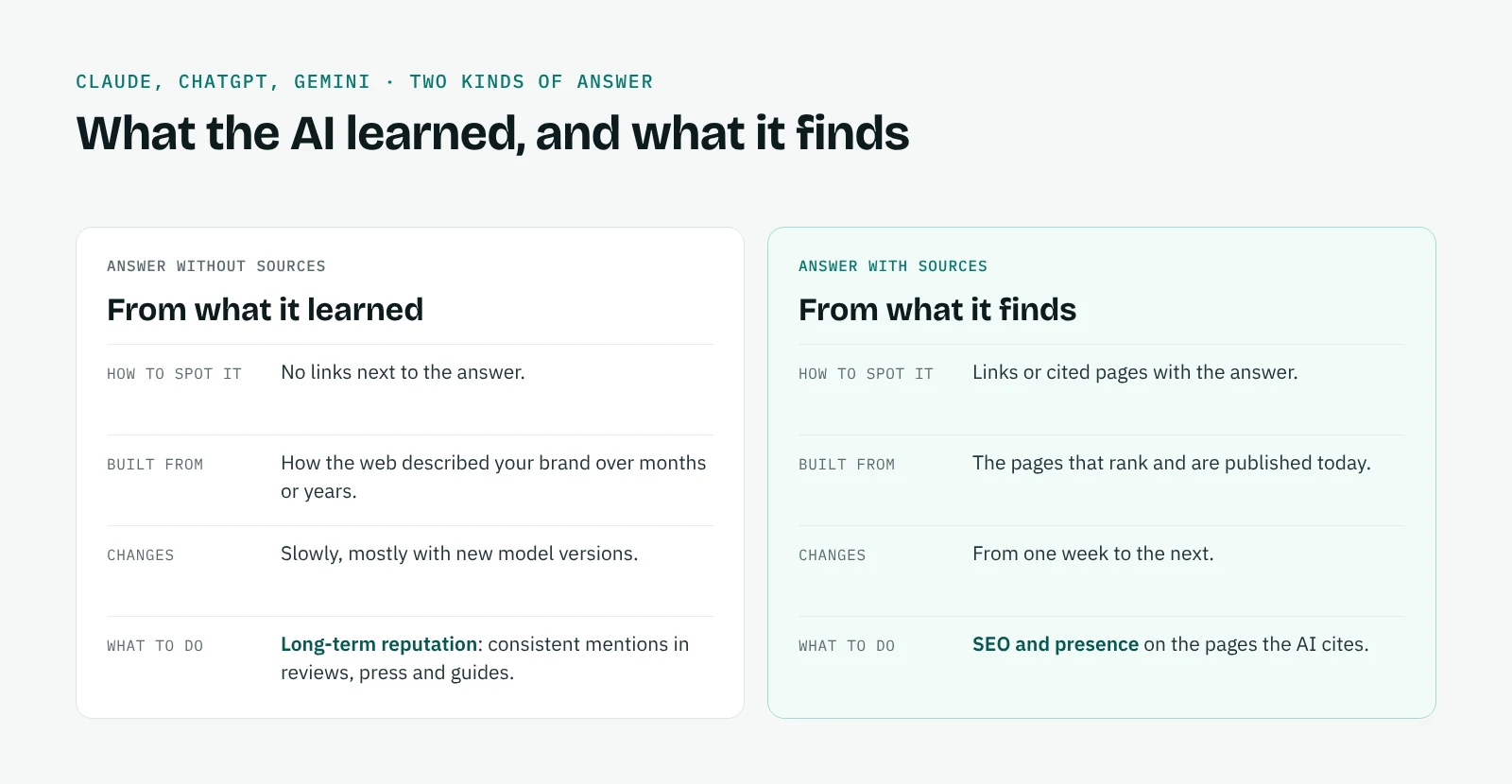
OpenAI adds that it increasingly uses synthetic data in some training steps, and that the model does not keep copies of what it read. It learns patterns, then writes new text from them. That is why an answer from training data has no link: there is no page behind it to point to.
Training data stops at a knowledge cutoff. Anything that happened after it, from a new product to a changed price, is unknown to the model unless it searches. And what it learned stays until a new model is trained. If ChatGPT describes your company the way the web described it two years ago, this is usually why.
Where ChatGPT gets current information: web search
When a question needs current or specific information, ChatGPT searches the web, either on its own or because the user asks it to. OpenAI's help center describes how it works:
- It rewrites your question into targeted queries and sends them to the search providers it partners with, and may send follow-up queries after reading the first results. OpenAI names Microsoft among those providers.
- The answer can include citations, and the Sources button lists the cited pages and other relevant links.
- To be eligible to appear, a site must allow OAI-SearchBot, OpenAI's search crawler. Blocking it keeps your pages out of ChatGPT's search answers. Placement is not guaranteed either way.
| Training data | Web search | |
|---|---|---|
| When it is used | Every answer | When the question needs current or specific information |
| How fresh | Up to the knowledge cutoff | The day you ask |
| Shows links | No | Yes, citations and a Sources list |
| What you can influence | What is written about you across the web, over years | The pages that rank and get cited for your topic, within weeks |
| How to check it | Ask questions with search off | Ask questions that trigger search and open the Sources |
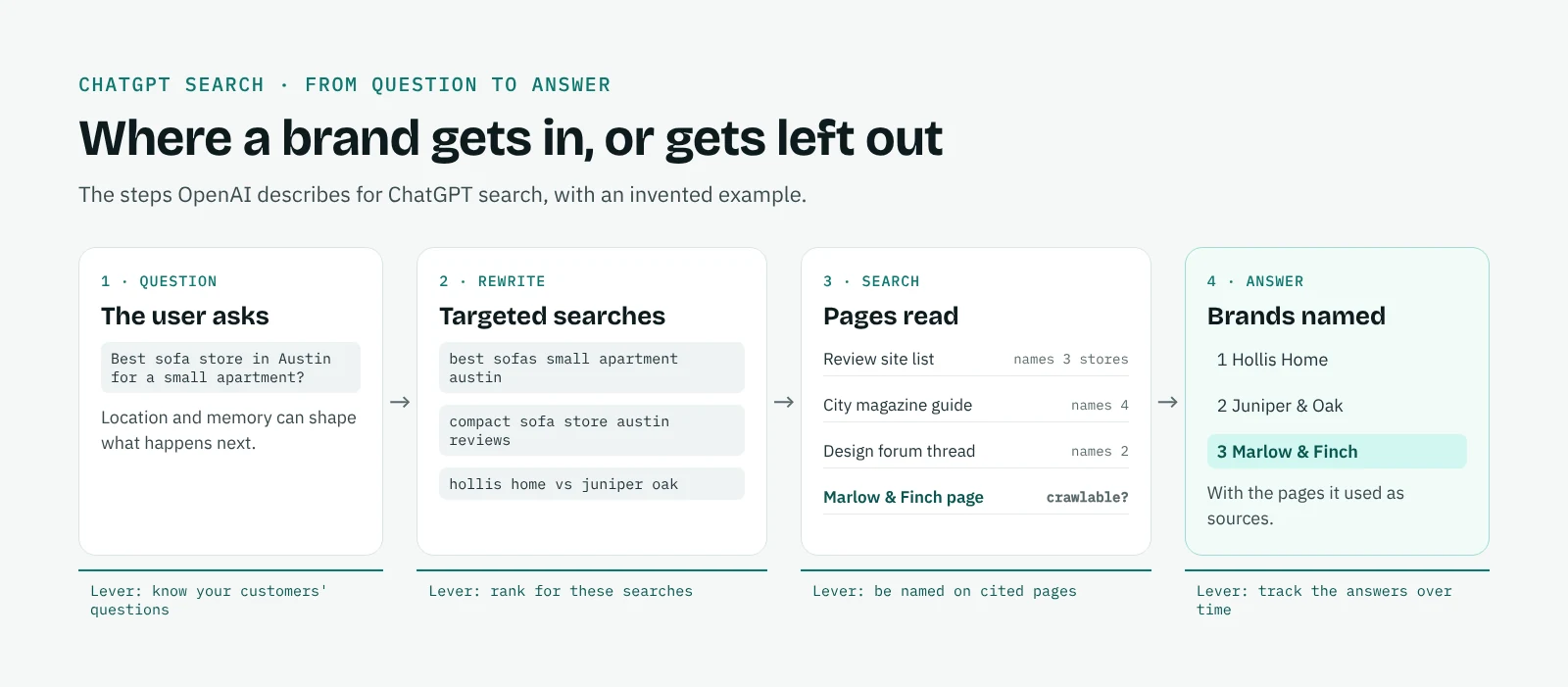
Most answers that recommend brands, products or local businesses now mix both: the model's general knowledge decides what kind of answer to give, and the pages it finds decide many of the names in it. Our guide on how to rank in ChatGPT follows that search path step by step.
What ChatGPT knows about you
If memory is on, ChatGPT can use details you shared and refer to past chats, and OpenAI says memory can also shape the searches it runs for you. That doesn't add new sources, but it changes which ones it looks for. It is one reason two people get different answers: our guide on why ChatGPT gives different answers to the same question covers the rest.
Which kinds of sources ChatGPT cites
The mix depends on the topic, and it is worth checking for yours rather than trusting a general list. In practice the cited pages fall into a few families:
Your own pages. Product, service and category pages, guides and FAQs that answer the question directly.
Review articles and roundups. "Best X for Y" articles from publishers and independent blogs are a frequent source for recommendation questions.
Directories, marketplaces and review platforms. For local businesses, maps and local listings; for software, review and comparison platforms; for products, retailers and marketplaces.
Forums and communities. Discussions where real users compare options.
News and reference pages, for questions about a company or a market.
What matters for a brand is which of these the assistants rely on for its own questions. A furniture brand may find that most citations go to three review roundups and one marketplace. A law firm may find that a legal directory and two of its competitors' blog posts dominate.
Do Gemini, Perplexity and Claude use the same sources?
No. Each assistant searches with its own systems, so the same question can cite different pages.
- Gemini draws on Google Search. Google AI Mode and AI Overviews use Google's index: a page has to be indexed and eligible for a snippet to be shown.
- Perplexity searches the web for its answers and shows its sources with every reply. Its search crawler is PerplexityBot.
- Claude can search the web and cites the pages it uses. Anthropic's search crawler is Claude-SearchBot.
This is why a brand can be visible on one platform and missing on another: the problem is often a different set of sources, not the brand's content as a whole. Track sources per platform.
How to find the sources ChatGPT cites for your topic
You can do this by hand for a first look. Take five to ten questions your customers ask (our guide on how to choose prompts to track AI visibility helps you pick them), and for each one:
- Open a new temporary chat, so memory doesn't steer the search.
- Ask the question. If ChatGPT answers without searching, ask it to search the web.
- Open Sources and copy every cited page into a spreadsheet.
- Note which brands the answer names, and which brands each cited page mentions.
- Repeat on Perplexity, Gemini and Google AI Mode.
One row per citation is enough:
| Date | Platform | Question | Cited page | Domain | Brands named on the page | Names you? |
|---|---|---|---|---|---|---|
| 2026-10-20 | ChatGPT | Best solid wood dining table under $2,000 | (page URL) | (domain) | Hollis Home, Juniper & Oak | No |
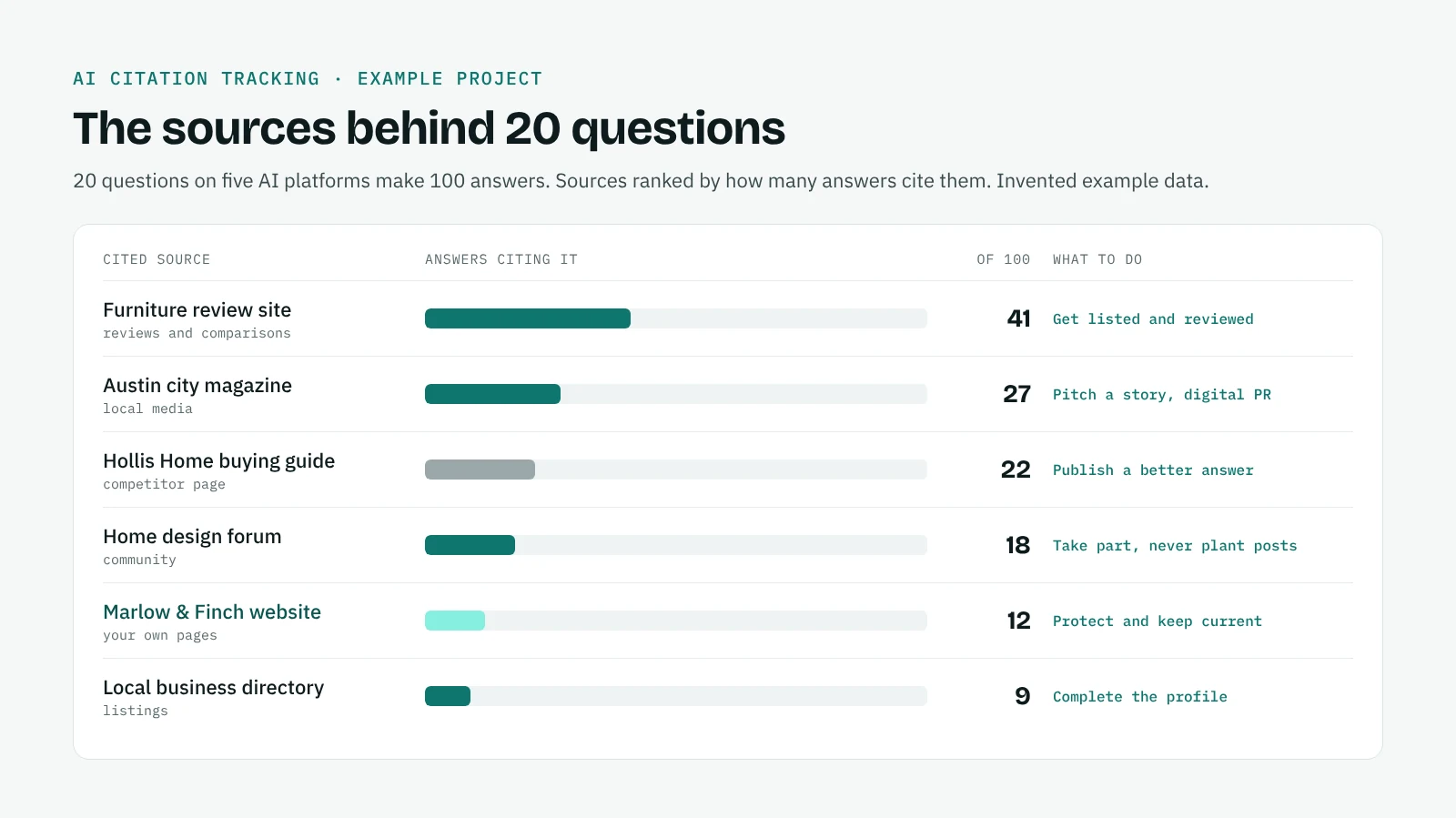
Sort by domain and count. The domains cited most often, on most platforms, are the sources that shape your category. The rows where a page names your competitors and not you are your list of opportunities. Our page on AI citation tracking explains how to keep this list up to date over time.
What to do with the list
Split the cited pages into three groups.
Your own pages. Check that each one answers the question in its first lines, with the facts an assistant needs: what you sell, for whom, prices, places, delivery. Make sure OAI-SearchBot, PerplexityBot and Claude-SearchBot are allowed in robots.txt.
Third-party pages you can influence. Review roundups that could include you, directory and marketplace listings to complete or correct, forum discussions where an honest answer from your team would help. These are usually the fastest wins. Our guide on how to improve brand visibility in AI search turns them into a plan.
Pages you can't influence. Note them and watch them: when one of them changes, the answers change too.
Tracking cited sources with QuotedBy
QuotedBy runs your questions in your own Chrome on ChatGPT, Claude, Gemini, Perplexity and Google AI Mode and saves every answer with its cited sources, its text and a screenshot. It ranks the cited sources across the whole project, lists them page by page for each question, and shows which sources appeared or disappeared since the previous run.
The free plan covers one project, three competitors and 20 questions on all five platforms. Pro, at 24 € a month, raises the limits and adds CSV and JSON export of the data.
Frequently asked questions
Where does ChatGPT get its information?
From two places: what it learned during training, from public web pages, licensed data and data provided by users and trainers, and what it finds through web search when a question needs current information.
Does ChatGPT use Google?
OpenAI doesn't say it uses Google. It says ChatGPT search sends queries to the search providers it partners with, and names Microsoft among them.
How does ChatGPT get its information about my business?
From what was published about your business before its training cutoff, and from the pages it finds when it searches: your site, directories, reviews, articles and forums.
What is the source of ChatGPT's answers?
Answers from training data have no single source and no links. Answers based on web search show citations and a Sources list with the pages used.
How do I get my website cited by ChatGPT?
Allow OAI-SearchBot to crawl your site, answer the questions your customers ask clearly on your own pages, and get listed in the third-party pages ChatGPT already cites for your topic.