Every AI visibility number rests on one decision: which questions you ask. Pick questions that name your brand and you will look visible everywhere. Pick a handful of odd wordings and every week will look different. The tool matters less than the set of prompts you give it.
This guide shows how to choose prompts to track AI visibility: how to start from what customers want rather than from keywords, why branded and non-branded prompts must stay apart, where persona prompts fit, where to find real questions, and how many you need.
Start from intents, not keywords
People don't type keywords into ChatGPT. They write a sentence, often with their situation in it: "I have a small living room and two kids, which sofa fabric is easiest to clean?". And they all write it differently. In the SparkToro study on AI recommendations, prompts that people wrote for the same need had a semantic similarity of only 0.081: the same intent, almost no shared wording.
The assistants then turn that sentence into several searches of their own. Google calls this query fan-out for AI Overviews and AI Mode, and ChatGPT search does the same with its search providers. So the exact wording of your prompt matters less than the intent behind it.
The practical rule: list the intents first, then write one natural question for each. An intent is a decision a customer is trying to make: choosing, comparing, finding an alternative, solving a problem, checking a price.
Branded and non-branded prompts measure different things
This is the mistake that inflates most AI visibility reports. A question that names your brand will almost always get an answer that names your brand. Mix those questions into the same rate as the others and the number goes up without anyone learning anything.
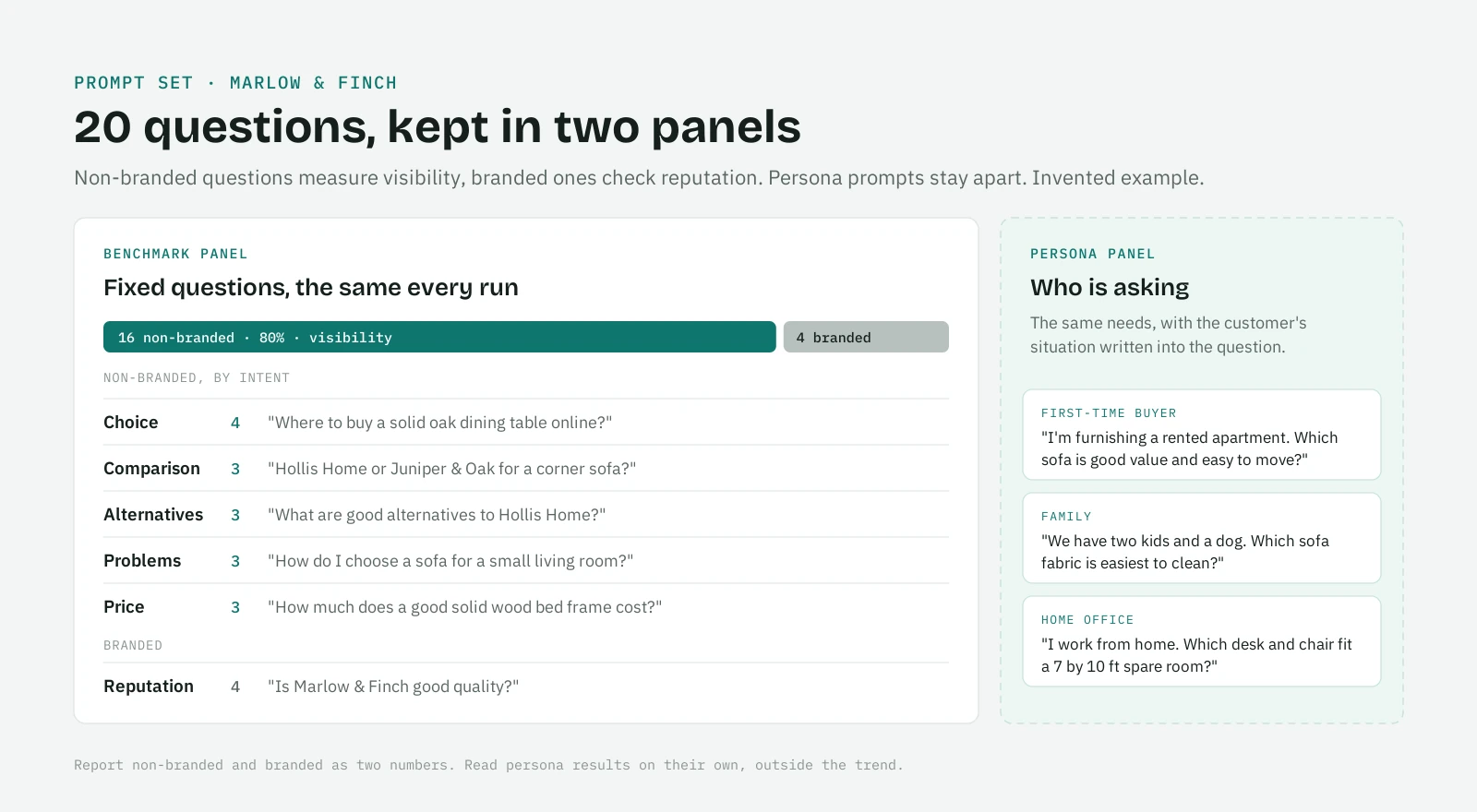
| Type | Example for a furniture brand | What it measures | Share of the set |
|---|---|---|---|
| Non-branded | "Best solid wood dining table under $2,000" | Visibility: are you recommended to someone who doesn't know you yet? | About 75 to 80% |
| Branded | "Is Marlow & Finch good quality?" | Reputation: what the assistants say about you, and whether it's right | About 20 to 25% |
Report them as two numbers. The non-branded visibility rate is the one that tells you whether AI search brings you new customers. The branded questions are a check on accuracy: old prices, discontinued products, wrong delivery times. Our guide to AI brand reputation explains what to do when the answers get you wrong.
A question that names a competitor ("alternatives to Hollis Home") counts as non-branded for you: it measures whether you are recommended in their place.
Group the questions by intent
Groups make the set easier to build and the results easier to read. Five groups cover most businesses. Here they are for Marlow & Finch, an invented furniture brand that sells online.
| Group | What the customer is doing | Example |
|---|---|---|
| Choice | Looking for the best option | "Where to buy a solid oak dining table online?" |
| Comparison | Weighing two named options | "Hollis Home or Juniper & Oak for a corner sofa?" |
| Alternatives | Looking beyond a known brand | "What are good alternatives to Hollis Home?" |
| Problems | Solving a need before choosing | "How do I choose a sofa for a small living room?" |
| Price | Checking what to expect to pay | "How much does a good solid wood bed frame cost?" |
Adapt the groups to the business. A local business adds the place to its questions ("family lawyer in Austin"); a software company adds integration and "best tool for" questions; a professional service gets most of its mentions from problem questions, where the assistants cite experts and their articles.
The groups also tell you where to act. If Marlow & Finch is named in choice questions and never in comparisons, the gap is in comparison content and in the review articles the assistants use for those answers. Our guide to AI competitor analysis shows how to read results by group.
Add persona prompts as a separate panel
The same question gets a different answer when the person asking describes themselves. A runner and a hiker asking for the best shoes under $130 should get different lists. Persona prompts put that context in the question: "I'm a first-time buyer furnishing a rented flat, which sofa is good value and easy to move?".
They are useful, but keep them apart. Treat your tracking as two panels:
- Benchmark panel: neutral questions with no personal context, run the same way every time. This is the trend line.
- Persona panel: questions written for each customer profile you care about. This shows who you are recommended to and who you are not.
Write the persona into the question, not into the account's memory or settings. Context stored in an account changes every answer from that account and can't be switched off for one question. Our guide on why ChatGPT gives different answers to the same question explains how memory affects the answers.
Where to find real questions
You don't have to invent the questions. Your customers have already asked most of them, somewhere.
Search Console. Long queries and queries phrased as questions are the closest thing to what people type into an assistant. In the Performance report, add a query filter, choose "Custom (regex)" and use one of these:
^(how|what|which|who|where|when|why|is|are|can|does|do|should)\b^(\S+\s+){5,}\S+$The first finds questions; the second finds queries of six words or more. Sort by impressions and keep the ones that describe a decision.
People also ask and related searches for your main topics.
Customer service, sales calls and emails. The questions people ask before buying are the ones they ask an assistant too.
Reviews and forums. Reddit threads and review sites show how customers describe their problem, in their own words.
The assistants themselves. Ask ChatGPT or Gemini what questions someone would ask before choosing a product like yours. Treat the list as ideas to check, not as data: nobody outside the AI companies knows the real questions and their volumes.
How many prompts you need
Enough to cover the intents, few enough to keep stable. For one brand or client:
- 20 questions is a solid start: four or five per group, with three or four of them branded. On five platforms that is 100 answers per run.
- 40 to 80 questions for a brand with several product lines, several markets or a persona panel.
- Fewer than 10 is too few: with nine questions, a single question that stops naming you on every platform moves the rate by about eleven points.
Practitioners who track AI visibility for clients tend to land in the same range: in a recent discussion among GEO specialists on Reddit, 20 to 30 questions per client, run monthly or more often, was the common answer. More questions also cost more time and money with any tool, so start small and add groups where the results raise questions.
Write prompts that behave like real questions
A few rules keep the answers comparable and close to what customers see.
Write the way a customer would. A full sentence, plain words, no marketing language.
Keep the brand out of non-branded questions, including product names that only you use.
Don't lead the answer. "Why is Marlow & Finch the best furniture brand?" tells you nothing.
One question per prompt. Two questions in one prompt get a long answer that is hard to compare.
Add the place when it matters. For a local business, the city or area belongs in the question.
Use the customer's language and market. Track English questions for the US and Italian ones for Italy, not a translation of the same set.
Leave dates out unless the question is about a season or an event. "Best sofas 2026" ages badly in a set you will keep for a year.
Keep the set stable
A question set is a measurement instrument. Change it and last month's numbers no longer compare with this month's.
Review the set once a quarter: drop questions that never produce useful answers, add new intents, and note the date of the change in your report. When you add a group of questions, read it as a new series for its first months instead of letting it move the overall rate. Our AI visibility report template has a place for this note in the appendix.
Setting up prompts in QuotedBy
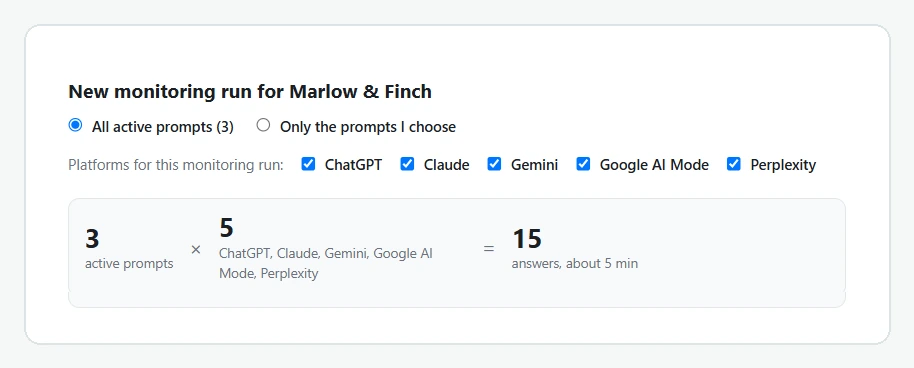
QuotedBy's guided setup starts from the type of client (local business, online store, professional or service, software or app) and what the client's customers are looking for, then proposes questions in groups. The questions that name the client are kept apart from the neutral ones, for the reason explained above. You can edit any proposed question with a click, write your own and label them, and the labels follow the questions into the results.
QuotedBy then runs the questions in your own Chrome on ChatGPT, Claude, Gemini, Perplexity and Google AI Mode and saves each answer with its sources. It also lists the brands the assistants name that you are not tracking: a good source of new comparison and alternative questions.
The free plan has 20 active questions on all five platforms for one project. Pro, at 24 € a month, raises the limit to 80 questions per project, suggests new questions with AI and imports question ideas from your Search Console queries. Our page on how to track brand mentions in AI search covers the rest of the setup.
Frequently asked questions
How many prompts should I track for AI visibility?
Start with about 20 per brand or client, spread over the main intents, with three or four branded questions among them. Go up to 40 to 80 for several product lines or markets.
Should I include my brand name in the prompts?
In a minority of them. Questions without the brand measure whether you are recommended to new customers; questions with the brand check what the assistants say about you. Report the two separately.
What are persona prompts?
Questions that include who is asking and their situation, such as a budget, a family or a use case. Keep them in a separate panel from the neutral questions you use for the trend.
Can I use my SEO keywords as prompts?
Use them as a starting point. Turn each keyword into the question a customer would ask, and prefer long, question-shaped queries from Search Console.
How often should I change the prompts?
Once a quarter at most, with the date of the change noted, so the monthly numbers stay comparable.